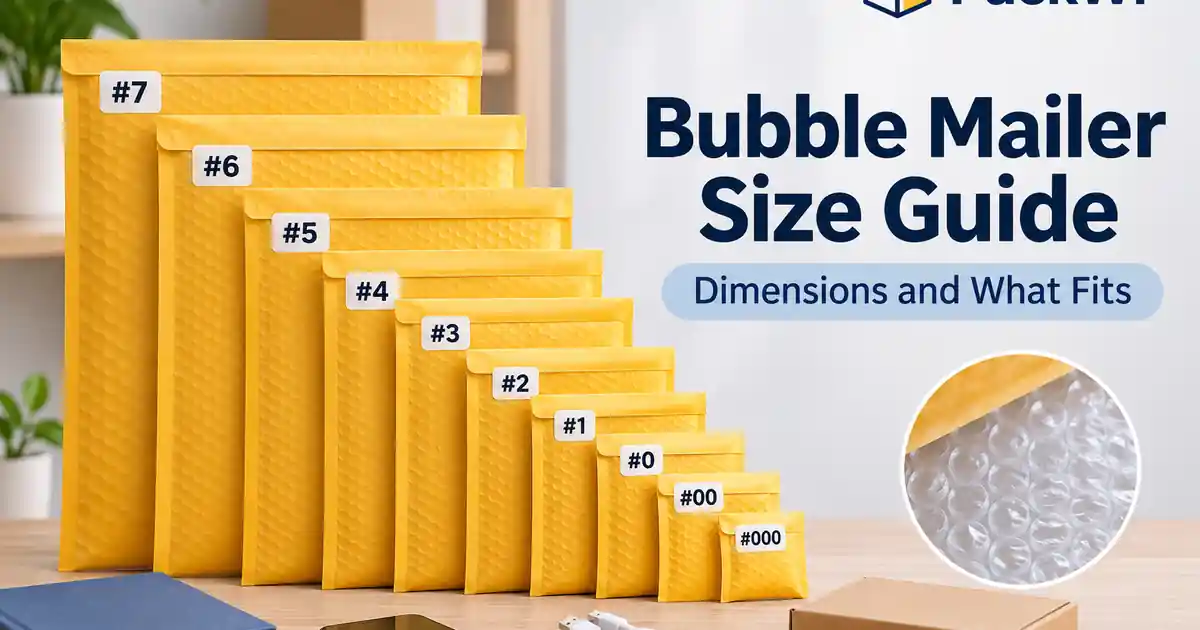

Finding the right padded envelope can be surprisingly confusing. A package labeled “#2 bubble mailer” might look large enough for your product, but the available space inside can be smaller than the dimensions printed on the packaging.
This bubble mailer size guide explains the most common numbered sizes, how much usable room they provide, and how to decide whether a padded envelope is suitable for your shipment.
You’ll also find practical measurement examples, a quick-reference size chart, and common mistakes to avoid before ordering mailers in bulk.
What Is a Bubble Mailer?
A bubble mailer is a shipping envelope with a protective bubble lining. Unlike a plain paper envelope, it offers a layer of cushioning around the contents.
Bubble mailers are commonly used for lightweight products such as:
- Phone accessories and charging cables
- Small clothing accessories
- Non-fragile cosmetic accessories
- Stationery and craft supplies
- Small books and printed products
- Lightweight replacement parts
They are available with different exterior materials, including kraft paper and plastic-based films.
However, a bubble mailer is not a substitute for a protective shipping box when an item is fragile, heavy, sharp, or easily crushed.
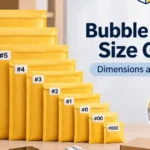
Bubble Mailer Size Chart: #000 to #7
Bubble mailers are commonly identified by numbers such as #000, #0, #2, and #4.
The number is a convenient size label, but the dimensions are what matter when choosing a mailer.
The following table shows measurements for a representative range of Uline bubble-lined mailers.
| Mailer size | Outside dimensions (W × L) | Usable inside dimensions (W × L) |
|---|---|---|
| #000 | 4 × 8 in | 3⅞ × 6¾ in |
| #00 | 5 × 10 in | 4⅞ × 8¾ in |
| #0 | 6 × 10 in | 5⅞ × 8¾ in |
| #1 | 7¼ × 12 in | 7⅛ × 10¾ in |
| #2 | 8½ × 12 in | 8⅜ × 10¾ in |
| #3 | 8½ × 14½ in | 8⅜ × 13¼ in |
| #4 | 9½ × 14½ in | 9⅜ × 13¼ in |
| #5 | 10½ × 16 in | 10⅜ × 14¾ in |
| #6 | 12½ × 19 in | 12⅜ × 17¾ in |
| #7 | 14¼ × 20 in | 14⅛ × 18¾ in |
Dimensions are in inches. Source: Uline Bubble-Lined Poly Mailers. These measurements apply to the listed product range, not every mailer sold under the same size number.
Important: A product that measures exactly the same as the usable inside dimensions may still be too thick to fit comfortably.
Before ordering, check the actual manufacturer’s specifications, including closure style, thickness, and the usable opening.
Internal vs. External Bubble Mailer Dimensions
One of the most common packaging mistakes is comparing a product’s size with a mailer’s outside dimensions.
External dimensions
External dimensions describe the overall width and length of the mailer as specified by the manufacturer.
They can include material that does not form part of the usable storage area, such as a folded closure flap.
Internal dimensions
Internal dimensions describe the usable width and length available for the contents.
The difference comes from the envelope’s construction, sealed edges, lining, and closure area.
For example, a #0 mailer in the table above has:
- Outside dimensions: 6 × 10 inches
- Usable inside dimensions: 5⅞ × 8¾ inches
An item measuring 6 inches wide will not fit flat inside an opening that provides only 5⅞ inches of usable width.
And even if the width fits, a thick product may need more room than a thin one.
The safest approach is to compare your packed item’s dimensions with the available internal space, not just the advertised outside size.
How to Measure an Item for a Bubble Mailer
You need three measurements:
- Width: The shorter face dimension of the item.
- Length: The longer face dimension.
- Thickness: How far the item extends when viewed from the side.
For a product in retail packaging, measure the retail package rather than the bare item.
Also include any additional protective material you plan to use.
Why thickness matters
Imagine placing a thin greeting card inside a padded envelope.
The mailer can remain almost flat, so very little of its width and length is consumed by the product’s thickness.
Now imagine inserting a rigid accessory box that is 2 inches thick.
The mailer’s material must bend around the box, leaving less room for its width and length.
This is why the same bubble mailer may fit a flat product but fail to accommodate a thicker object with similar face dimensions.
A useful starting calculation
Uline provides a sizing guideline for estimating minimum outside mailer dimensions:
Estimated mailer width = Product width + Product thickness + 1½ inches
Estimated mailer length = Product length + Product thickness + 3½ inches
This method helps account for the extra material needed to wrap around the product and close the envelope.
It is a starting point, not a guarantee of fit for every mailer design.
Example 1: Choosing a Mailer for a Small Accessory Pack
Suppose you are shipping a packaged accessory measuring:
| Measurement | Product size |
|---|---|
| Width | 5 inches |
| Length | 7 inches |
| Thickness | 0.5 inch |
Using the sizing guideline:
Estimated width: 5 + 0.5 + 1.5 = 7 inches
Estimated length: 7 + 0.5 + 3.5 = 11 inches
You should look for a mailer with outside dimensions of approximately 7 × 11 inches or larger, while checking the manufacturer’s usable interior.
In the chart above, a #1 mailer measuring 7¼ × 12 inches externally is a reasonable candidate.
Its listed usable interior is 7⅛ × 10¾ inches.
Before buying a large quantity, test one mailer with the actual packaged product.
Example 2: Choosing a Mailer for a Larger Flat Product
Now consider a non-fragile item measuring:
- Width: 8 inches
- Length: 10 inches
- Thickness: 0.5 inch
The estimated minimum outside dimensions become:
Width: 8 + 0.5 + 1.5 = 10 inches
Length: 10 + 0.5 + 3.5 = 14 inches
A #5 mailer measuring 10½ × 16 inches externally would be worth evaluating.
However, if the product has rigid corners or could be damaged by bending, a corrugated mailer or box may be a better choice.
The goal is not simply to find something that fits. It is to find packaging that protects the product during normal handling.
What Fits in Common Bubble Mailer Sizes?
The following examples can help narrow down your options.
| Mailer size | Products worth checking |
|---|---|
| #000 | Small flat accessories, stickers, lightweight parts |
| #00 | Compact stationery, small cables, flat accessories |
| #0 | Small accessory packs, thin cosmetic accessories |
| #1 | Compact boxed accessories, small stationery sets |
| #2 | Larger accessory packs, certain slim books |
| #3 | Longer stationery products, medium flat items |
| #4 | Some paperback books or larger accessory packs |
| #5 | Selected lightweight garments or flat merchandise |
| #6–#7 | Larger soft goods and other suitable non-fragile products |
These are examples, not guaranteed fit recommendations. Products in the same category can vary significantly in their dimensions and thickness.
For example, one paperback book may fit in a padded envelope, while a thicker hardcover book may need a corrugated mailer or box to protect its corners and cover.
Always measure the actual item.
Bubble Mailer vs. Poly Mailer vs. Shipping Box
Choosing the correct dimensions is important, but so is choosing the right packaging type.
Bubble mailer
A padded envelope with built-in cushioning.
Often suitable for: Lightweight, relatively durable goods that need limited protection from rubbing and minor impacts.
Limitations: It does not provide the same crush resistance as a rigid box.
Poly mailer
A flexible mailing bag without built-in bubble cushioning.
Often suitable for: Folded clothing, textiles, and other soft, non-fragile products.
Limitations: It offers little impact protection.
Corrugated shipping box
A rigid container made from corrugated cardboard.
Often suitable for: Fragile, heavy, crushable, or irregularly shaped products.
Limitations: It generally takes up more space and may require additional cushioning.
If you’re unsure whether a box would be better, read our related guide: How to Choose the Right Shipping Box Size.
When Should You Avoid a Bubble Mailer?
Bubble mailers are convenient, but they are not suitable for every shipment.
Consider using a stronger shipping box when the product:
- Is made from fragile glass or ceramic
- Contains a screen or another easily damaged component
- Has sharp edges that could puncture the envelope
- Is heavy enough to strain the seams
- Must not bend or become compressed
- Requires specific protective packaging under carrier rules
FedEx’s packaging guidance notes that bubble and padded mailers provide limited cushioning for non-fragile items.
For delicate goods, the small amount of cushioning built into an envelope may not provide adequate protection.
Can Bubble Mailers Qualify for Letter or Flat Shipping Rates?
Not automatically.
A padded envelope’s postal classification depends on factors such as its final size, thickness, flexibility, weight, and the applicable service.
For example, USPS has separate physical standards for letters, large envelopes (flats), and parcels.
An envelope can meet a general size range for flats but still fail to qualify if it is too rigid, unevenly thick, or otherwise does not meet the relevant standards.
This is especially important when shipping rigid products inside padded envelopes.
Don’t assume that using a bubble mailer automatically makes a shipment eligible for cheaper letter postage.
Check the carrier’s current rules and measure the completely packed mailer before purchasing postage.
Five Common Bubble Mailer Sizing Mistakes
1. Comparing the product to the outside dimensions
A 6-inch-wide item may not fit in a mailer advertised as 6 inches wide.
Better approach: Check the usable inside width and allow for thickness.
2. Forgetting to measure the packaged product
Retail packaging, cardboard inserts, and protective wrapping can increase the required space.
Better approach: Measure the product in the condition in which it will be shipped.
3. Choosing the smallest possible envelope
An overly tight fit may strain the seams or make the adhesive closure difficult to secure.
Better approach: Leave enough room for proper closure without forcing the contents inside.
4. Assuming padded means crush-proof
The bubble lining offers limited cushioning but cannot prevent all crushing or bending.
Better approach: Match the packaging type to the product’s vulnerability.
5. Buying mailers in bulk without testing one
Even mailers with similar size labels can differ in construction and usable space.
Better approach: Pack a sample item, close the envelope, and inspect the fit before placing a large order.
A Quick Bubble Mailer Selection Checklist
Before choosing a bubble mailer, confirm that:
- You measured the item’s width, length, and thickness.
- You included any retail packaging or protective wrapping.
- You checked the mailer’s usable internal dimensions.
- The contents fit without stretching or distorting the envelope.
- The product does not require a rigid protective box.
- The adhesive flap can close securely.
- The finished package meets the carrier’s applicable requirements.
This short check can prevent purchasing unsuitable packaging and help you prepare more consistent shipments.
Frequently Asked Questions
What is the smallest common bubble mailer size?
Size #000 is among the smallest commonly listed numbered bubble mailers. In the Uline product range, it measures 4 × 8 inches externally, with a usable interior of 3⅞ × 6¾ inches.
What is the difference between a #0 and #00 bubble mailer?
In the reference chart, a #00 mailer measures 5 × 10 inches externally, while a #0 measures 6 × 10 inches. Their listed usable lengths are the same, but the #0 offers more usable width.
What size bubble mailer fits a paperback book?
It depends on the book’s width, height, and thickness. Measure the entire book and compare those measurements with a mailer’s usable interior. A rigid or valuable book may be better protected in a corrugated mailer or box.
Can I use a bubble mailer for clothing?
Yes, some lightweight garments and soft accessories may be suitable for bubble mailers. However, a non-padded poly mailer may also be sufficient for certain non-fragile textiles.
Do bubble mailer sizes include the sealing flap?
It depends on how the manufacturer reports its measurements. Some advertised outside dimensions include a folded flap, while the usable inside dimensions exclude closure space. Always check the product specifications.
Is a bigger bubble mailer always safer?
No. Excessive empty space can allow the contents to move around. Choose a size that provides adequate room without unnecessarily loose packaging.
Final Thoughts
A reliable bubble mailer size guide should help you answer three questions:
- Will my packed product fit inside the usable space?
- Does the mailer provide enough protection for this particular item?
- Will the completed shipment meet the carrier’s packaging and postage requirements?
Start with accurate measurements, pay attention to thickness, and compare the actual internal dimensions of the mailer.
If possible, test one envelope before buying in bulk.
For products that need stronger protection, consider a corrugated box instead of forcing them into a padded mailer.
Explore more practical packaging information in the Box & Mailer Sizes and Packaging Guides sections of PackWi.
Sources and Further Reading
- Uline — Bubble-Lined Poly Mailer Dimensions
- Uline — Mailer Sizing Guide
- FedEx — General Guidelines for Polybags and Soft Mailers
- USPS — Physical Standards for Letters, Flats, and Parcels
PackWi provides general packaging information. Mailer dimensions, product fit, and postal requirements can vary by supplier, carrier, and shipping service.