
Choosing the right shipping box size is about more than finding a container that fits your item. A well-sized box provides enough room for protective materials, helps reduce unnecessary empty space, and makes the package easier to prepare for shipping.
A box that is too small may put pressure on the contents. A box that is too large may allow items to shift during transportation and could increase shipping costs.
In this guide, we’ll explain how to measure your items, calculate the space needed for cushioning, understand shipping box dimensions, and make a practical decision before packing.
1. Measure Your Item Before Choosing a Box
Start by measuring the item you want to ship.
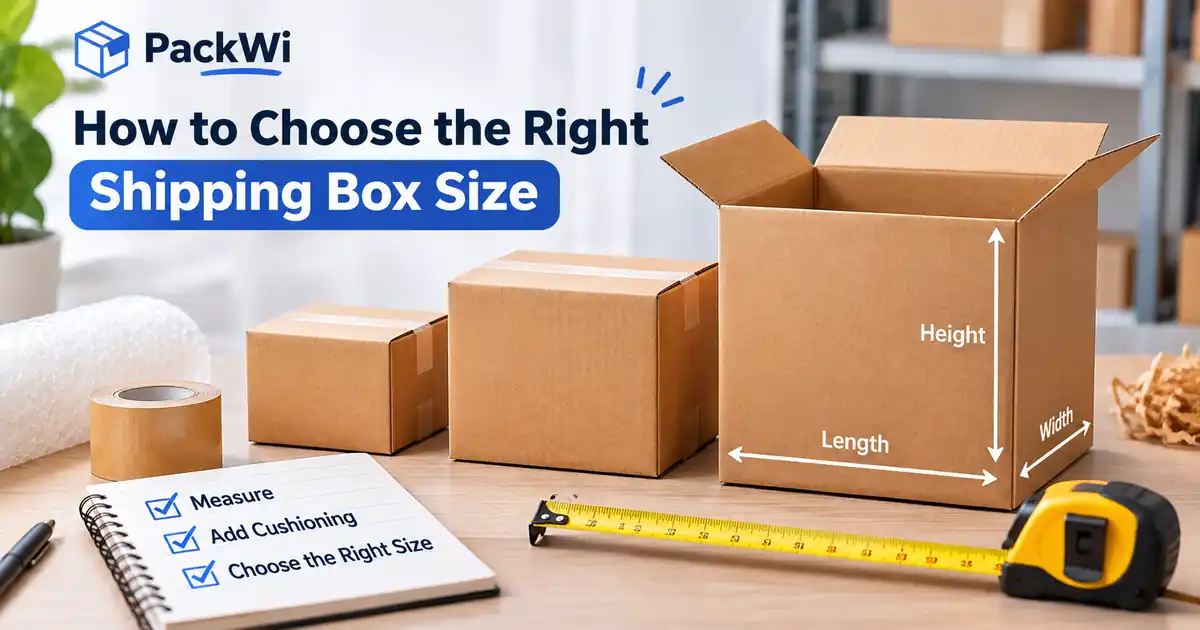
You will need three measurements:
- Length: The longest side of the item.
- Width: The measurement across the second side.
- Height: The remaining dimension.
Measure the item in the position in which it will be packed. If it has a handle, protruding part, or protective retail packaging, include that in your measurements.
For example, imagine you want to ship a small electronic device with these dimensions:
| Measurement | Item size |
|---|---|
| Length | 9 inches |
| Width | 6 inches |
| Height | 4 inches |
A box measuring exactly 9 × 6 × 4 inches would leave almost no room for cushioning.
That is why measuring the item is only the first step.
2. Allow Enough Space for Protective Packaging
The ideal box must fit both the product and the materials used to protect it.
Depending on the item, you may need:
- Bubble wrap for cushioning delicate surfaces.
- Packing paper to reduce movement.
- Foam inserts for sensitive or irregularly shaped items.
- Air pillows or other suitable void-fill materials.
- Dividers to separate multiple products.
The amount of cushioning depends on the item’s fragility, weight, shape, and the packaging material used.
For fragile items, it can be appropriate to allow approximately 2 inches of protective cushioning on every side, following the relevant carrier’s guidance.
A practical box-sizing example
Let’s use the 9 × 6 × 4-inch electronic device from our earlier example.
If you allow 2 inches of cushioning on each opposite side, the calculation becomes:
| Dimension | Calculation | Required internal space |
|---|---|---|
| Length | 9 + 2 + 2 | 13 inches |
| Width | 6 + 2 + 2 | 10 inches |
| Height | 4 + 2 + 2 | 8 inches |
The resulting target is 13 × 10 × 8 inches of usable internal space.
This is an illustrative calculation, not a universal box recommendation. The finished item may require a different arrangement, and the cushioning must actually protect the product without leaving it loose.
If that exact box size is unavailable, choose a suitable available size that provides adequate protection without excessive empty space.
3. Understand Internal and External Box Dimensions
One detail that can cause confusion is the difference between the inside and outside measurements of a cardboard box.
Internal dimensions describe the usable space inside the box. These are especially important when deciding whether an item and its cushioning will fit.
External dimensions describe the outside measurements of the fully assembled package. Shipping carriers generally use the package’s external measurements when determining size-related shipping charges.
For example, a box advertised with internal dimensions of 12 × 9 × 6 inches may have slightly larger outside measurements because of the cardboard thickness.
Before buying packaging supplies, check whether the seller lists internal or external measurements.
And before purchasing a shipping label, measure the completed package rather than relying only on the dimensions printed on the box listing.
4. Choose the Box According to the Item
Not every product needs the same type of shipping container.
| Item type | Packaging consideration |
|---|---|
| Books and printed materials | Use a rigid mailer or snug box that protects edges and corners |
| Clothing and soft goods | A suitable mailer may reduce unnecessary packaging |
| Fragile ceramics or glass | Use a strong box, substantial cushioning, and consider double-boxing |
| Small electronics | Protect against impact and movement, using appropriate protective materials |
| Heavy products | Consider a stronger, double-wall corrugated box |
| Multiple small items | Wrap or separate items so they cannot strike one another |
These are starting points rather than fixed rules. The actual choice depends on weight, fragility, product shape, destination, and the shipping service’s packaging requirements.
For instance, a folded T-shirt may fit safely in a suitable mailer, while a ceramic mug usually requires a rigid box and protective cushioning.
Choosing packaging based on the product helps avoid wasting materials while still prioritizing protection.
5. Avoid Choosing a Box That Is Unnecessarily Large
A large box is not automatically a safer box.
Too much unfilled space can allow an item to move. Even if the empty space is filled, the package may use more cardboard and cushioning than necessary.
Package size can also affect shipping costs.
Some shipping services calculate dimensional weight, which considers the amount of space a package occupies.
The general formula is:
Dimensional weight = Length × Width × Height ÷ Carrier divisor
The divisor depends on the carrier, service, measurement units, and applicable rate agreement.
Consider two hypothetical boxes:
| Box | External dimensions | Volume |
|---|---|---|
| Box A | 13 × 10 × 8 inches | 1,040 cubic inches |
| Box B | 16 × 12 × 8 inches | 1,536 cubic inches |
Box B occupies about 48% more volume than Box A.
That doesn’t automatically mean shipping will cost 48% more. It does show why measuring the final package matters, particularly when dimensional-weight pricing applies.
The goal is to find the smallest safely usable box, not simply the smallest box available.
6. Check the Strength of the Cardboard
Box dimensions alone don’t tell you whether the packaging is strong enough.
A lightweight product and a heavy machine component may fit inside boxes with the same dimensions, but they shouldn’t necessarily use the same cardboard construction.
Corrugated shipping boxes are available in different strengths and wall constructions.
When choosing a box, consider:
- The weight of the item.
- Whether the product has sharp edges or concentrated pressure points.
- The possibility of stacking during transport.
- Whether the box has been used before.
- The carrier’s packaging recommendations.
Heavy or fragile shipments may benefit from stronger corrugated cardboard or double-wall construction.
If you reuse a box, inspect its corners, seams, and panels. Avoid boxes that are crushed, damp, torn, or visibly weakened.
Remove or completely cover outdated shipping labels and barcodes.
7. Test the Packed Box Before Sealing It
Before sealing the package, perform a simple packing check.
Check the fit. The item should fit without forcing the box panels outward.
Check the cushioning. Protective materials should surround the item where needed, including at the bottom and top.
Check for movement. Items should not slide around inside the box. For fragile products, inspect the fit carefully rather than shaking them aggressively.
Check the box shape. The package should close naturally, without bulging or damaged flaps.
Check the weight. The cardboard and packing method must be suitable for the finished package.
Once everything is secure, close the box using appropriate packaging tape. Seal the center seam and edge seams using the H-taping method where recommended.
Finally, measure and weigh the sealed package before purchasing the shipping label.
8. Common Shipping Box Size Mistakes
Choosing a box based only on the product dimensions
The product may technically fit, but there may be insufficient space for protective materials.
Better approach: Measure the wrapped or cushioned item, not just the bare product.
Using a large box to avoid measuring
A much larger box may increase the amount of filling material required and affect dimensional-weight charges.
Better approach: Compare several suitable box sizes before packing.
Confusing internal and external dimensions
A box’s listed internal dimensions may be different from the outside measurements used for shipping.
Better approach: Confirm the supplier’s measurement convention and measure the final package.
Reusing a damaged box
A previously used box may have lost strength even if its dimensions are correct.
Better approach: Use an undamaged shipping-grade box appropriate for the item.
Leaving multiple items loose
Even a properly sized box can provide poor protection if individual products collide during transportation.
Better approach: Wrap, separate, and immobilize items as needed.
9. A Simple Shipping Box Size Checklist
Before preparing your next shipment, ask yourself:
- Have I measured the complete item, including any protruding parts?
- Have I allowed enough room for appropriate cushioning?
- Does the box support the item’s weight?
- Is unnecessary empty space minimized?
- Have I checked whether the box measurements are internal or external?
- Will the item stay protected throughout normal handling?
- Have I measured and weighed the sealed package?
If you can answer these questions confidently, you are in a much better position to choose practical packaging.
Frequently Asked Questions
Should a shipping box be slightly bigger than the item?
Usually, yes. The box needs enough additional space for any required cushioning. The amount depends on how fragile the item is and which protective materials you use.
How do I calculate the box size I need?
Measure the item’s length, width, and height. Add the required cushioning allowance to both sides of each dimension. Then look for a box with sufficient usable internal dimensions.
Is it cheaper to ship with a smaller box?
Sometimes. A smaller package may use fewer materials and reduce dimensional weight. However, shipping prices depend on the carrier, service, weight, destination, and other factors. Never reduce protective packaging solely to lower the shipping price.
Are shipping box sizes measured from the inside or outside?
Boxes sold by packaging suppliers are often described using internal dimensions. Shipping carriers generally rely on the external dimensions of the completed package. Always confirm the measurement method.
Can I ship a product without a cardboard box?
Some items, such as soft clothing, may be suitable for shipping in an appropriate mailer. Fragile, heavy, or easily crushed products usually need stronger protection. Always check the packaging requirements for the shipping service you plan to use.
Final Thoughts
The right shipping box size balances product protection, usable space, material efficiency, and shipping requirements.
Start with accurate item measurements, allow room for suitable cushioning, and choose a strong box that minimizes unnecessary space. Before sending the package, measure its outside dimensions and check its final weight.
A few minutes spent choosing the right box can help you avoid common packing mistakes and prepare a more reliable shipment.
For more practical packaging information, explore the Packaging Guides and Box & Mailer Sizes sections on PackWi.
References and further reading
- FedEx — Packing Tips and How-to Guides
- UPS — Shipping Dimensions and Weight
- USPS — How to Prepare and Send a Package
PackWi provides general packaging information. Specific carrier requirements and charges may vary by service, location, and shipment.