

Choosing a shipping box isn’t just about finding the right dimensions. Two boxes can have almost identical length, width, and height measurements while offering different levels of strength.
One of the most important differences is their construction: single wall vs double wall boxes.
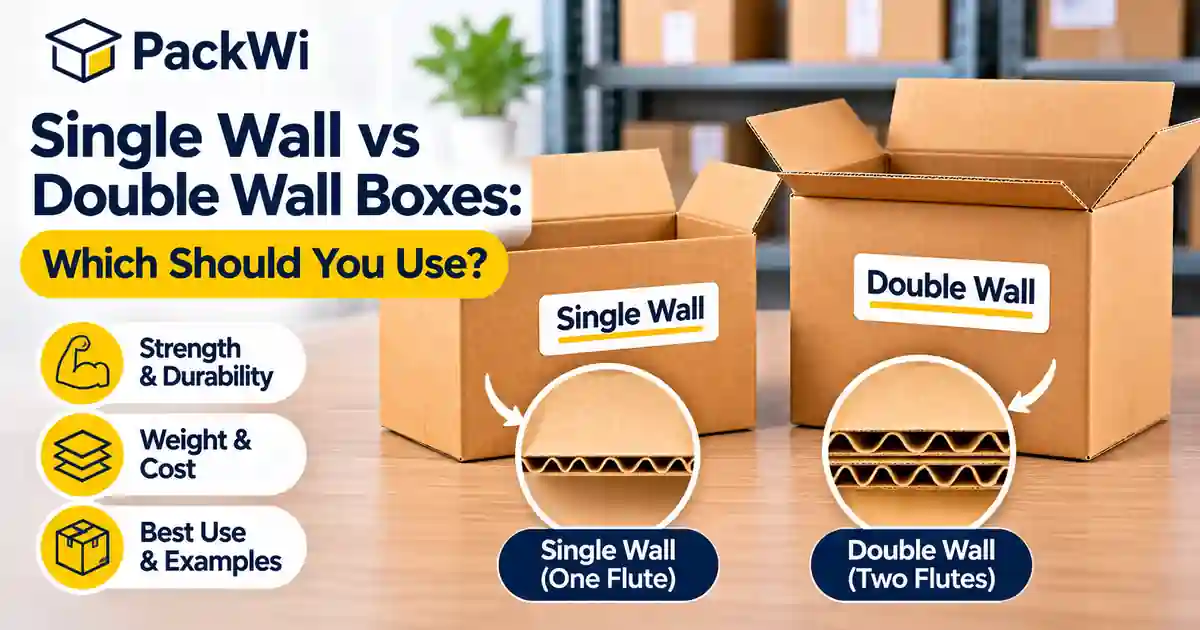
A single-wall box uses one layer of corrugated fluting between two flat paper liners. A double-wall box uses two layers of fluting separated by an additional liner.
That extra layer can provide more structural support, but it doesn’t mean double-wall cardboard is always the best choice for every shipment.
This guide explains how both constructions work, how to understand box strength ratings, and how to choose suitable packaging for lightweight, heavy, or fragile items.
What Is a Single-Wall Corrugated Box?
A single-wall corrugated box is made from three main paper layers:
- An outer flat liner.
- One corrugated, wave-shaped paper layer called the fluting.
- An inner flat liner.
The corrugated middle layer creates spaces between the liners and helps the cardboard resist bending and compression.
Single-wall boxes are common because they offer a useful balance of strength, weight, material use, and cost.
They can be suitable for many everyday shipments, including products that are reasonably durable and not unusually heavy.
Examples worth considering include:
- Packaged stationery
- Lightweight household accessories
- Clothing packed in a box
- Books with appropriate protection
- Small consumer products
- Suitable non-fragile retail merchandise
However, not every single-wall box has the same strength.
The paper grade, flute design, box dimensions, and tested board rating all affect performance.
A correctly specified single-wall box can be a better choice than an incorrectly specified double-wall box.
What Is a Double-Wall Corrugated Box?
A double-wall corrugated box combines five main paper layers:
- An outer liner.
- A first corrugated layer.
- A middle liner.
- A second corrugated layer.
- An inner liner.
The two fluted layers create a thicker structure that can provide additional strength and rigidity.
Double-wall boxes are commonly considered for:
- Heavier products
- Shipments that need extra structural support
- Large boxes carrying substantial loads
- Certain fragile goods
- Boxes that may experience stacking pressure
- Products shipped through demanding distribution conditions
Double-wall cardboard generally uses more material than a comparable single-wall construction.
It may also be heavier, thicker, and more expensive.
For some shipments, these trade-offs are worthwhile. For others, they add unnecessary packaging.
Single Wall vs Double Wall Boxes: Quick Comparison
| Feature | Single-wall box | Double-wall box |
|---|---|---|
| Corrugated layers | One | Two |
| Main paper layers | Three | Five |
| Typical board thickness | Thinner | Thicker |
| Material use | Generally lower | Generally higher |
| Box weight | Often lighter | Often heavier |
| Structural rigidity | Depends on board grade | Often greater for comparable designs |
| Cost | Often lower | Often higher |
| Suitable applications | Many everyday shipments | More demanding or heavier shipments |
| Protection for fragile items | Requires suitable cushioning | Still requires suitable cushioning |
This comparison describes common differences between the constructions.
Wall count alone does not establish a box’s safe weight limit or guarantee that the contents will survive transportation.
For a reliable choice, consider the box’s tested strength rating, dimensions, contents, and expected handling conditions.
Does Double-Wall Cardboard Mean Twice the Strength?
No.
Double-wall corrugated board contains two fluted layers, but that doesn’t mean it is automatically twice as strong as a single-wall alternative.
Box performance depends on several variables:
- Paper quality and strength
- Flute profiles and combinations
- Board manufacturing quality
- Adhesive bonds
- Box size and shape
- Direction of the applied force
- Moisture exposure
- How the package is filled and supported
A high-strength single-wall box may perform differently from a lower-grade double-wall box.
The correct comparison should be based on relevant test results rather than appearance alone.
Two important ratings help explain this distinction: the Edge Crush Test (ECT) and the Mullen Burst Test.
Understanding ECT Ratings on Shipping Boxes
ECT stands for Edge Crush Test.
It measures the force needed to crush a sample of corrugated board when pressure is applied along its edge.
In U.S. packaging specifications, ECT is commonly expressed in pounds of force per linear inch.
An ECT rating is useful when evaluating the board’s contribution to a box’s resistance to vertical compression.
This matters when packages may be stacked during storage or transportation.
What Does 32 ECT Mean?
A box marked 32 ECT is made from corrugated board rated to meet a minimum edge-crush strength of 32 pounds-force per linear inch under the applicable test.
The marking does not mean the completed box can safely hold exactly 32 pounds of products.
Those are two different measurements.
The amount of weight a finished box can safely contain depends on its construction, dimensions, condition, and handling environment.
What About 44 ECT or 48 ECT?
Higher ECT values indicate greater rated edge-crush resistance under the relevant test.
For example:
| ECT rating | What the number describes |
|---|---|
| 32 ECT | A minimum edge-crush strength rating |
| 44 ECT | A higher minimum edge-crush strength rating |
| 48 ECT | A still higher minimum edge-crush strength rating |
These values are not direct package-weight limits.
A rating should be considered alongside the specific wall construction and other box requirements.
For example, a 48 ECT double-wall box and a 44 ECT single-wall box differ in more than just the number printed on the carton.
If you’re selecting packaging for heavy products, review the supplier’s actual specifications rather than assuming that every box with the same ECT rating performs identically.
ECT vs. Mullen Burst Test: What’s the Difference?
Corrugated boxes may also be described using a Mullen Burst Test rating.
These tests assess different properties.
Edge Crush Test
ECT evaluates how corrugated board performs under edgewise compression.
It is particularly relevant to understanding the board’s contribution to stacking strength.
Mullen Burst Test
The Mullen Burst Test measures the pressure required to rupture a sample of corrugated board.
It is used to assess the board’s resistance to bursting forces.
Which Rating Should You Check?
| Test | Main property measured | Why it matters |
|---|---|---|
| Edge Crush Test (ECT) | Edgewise compression resistance | Helps assess compression-related performance |
| Mullen Burst Test | Resistance to rupture under pressure | Helps assess resistance to certain puncture or bursting forces |
Neither rating fully describes the impact protection of a completed shipment.
For example, a box with a suitable compression rating may still fail to protect a glass ornament if the item isn’t adequately cushioned.
Board strength and product cushioning are two separate parts of effective packaging.
How to Read the Box Manufacturer’s Certificate
Many corrugated shipping boxes have a circular stamp printed on a bottom flap.
In the United States, this is commonly called a Box Manufacturer’s Certificate, or BMC.
Depending on the box and the certification format, the stamp can identify:
- The manufacturer
- Whether the box is single wall or double wall
- The stated board strength test
- A size limit
- A gross weight limit
- Other manufacturer or specification information
The certificate helps identify the box’s intended construction and ratings.
Why This Matters
Imagine you’re choosing between two boxes that look almost identical.
The first is a single-wall box with one tested strength specification.
The second is a double-wall box with a different specification.
Instead of judging them by appearance, you can compare the ratings and restrictions provided by the manufacturers.
If a supplier doesn’t provide adequate specifications, ask for the relevant board grade, strength rating, and intended application before using the box for a demanding shipment.
Also remember that a printed certificate doesn’t mean every packing method or product is automatically safe.
When Should You Choose a Single-Wall Box?
A suitable single-wall box can be an efficient option when the contents are relatively lightweight, reasonably durable, and adequately protected.
Consider the following example.
Example: Shipping a Packaged Desk Accessory
Suppose you’re shipping a small, non-fragile desk organizer.
The finished item is relatively light, and you have a well-fitting single-wall corrugated box with a suitable manufacturer-rated strength.
You also add enough material to prevent the organizer from moving during transport.
In this situation, the single-wall box may provide adequate containment and protection without the additional material of a double-wall construction.
Choosing double wall automatically might add cost and packaging weight without providing a meaningful benefit for that particular product.
However, the box’s tested specifications and the item’s actual characteristics still determine whether it is appropriate.
Other Factors Supporting Single Wall
Single-wall construction may be worth considering when:
- The item doesn’t need unusually high structural protection.
- The box has an appropriate rated strength.
- The package is not excessively large.
- The expected distribution conditions are manageable.
- Proper cushioning and sealing can be provided.
The goal is to choose an adequate box, not simply the lightest one.
When Is a Double-Wall Box Worth Considering?
Double-wall construction may be more appropriate when a shipment places greater demands on the packaging.
Example: Shipping a Heavy Replacement Component
Imagine shipping a dense replacement part.
Although the component fits inside a relatively compact box, its weight creates concentrated pressure on the container.
The item may also have hard corners that need to be separated from the cardboard walls.
For this shipment, you should evaluate:
- The total packed weight
- The box’s rated strength
- The product’s shape and pressure points
- Suitable internal supports or inserts
- The likelihood of stacking during transport
- Whether double-wall construction is appropriate
A properly specified double-wall box may be a reasonable choice.
However, simply placing the heavy component in a larger double-wall carton with loose paper would not create reliable packaging.
The product must still be immobilized and appropriately supported.
Other Reasons to Consider Double Wall
- Large cartons carrying substantial contents
- Shipments requiring additional structural rigidity
- Certain storage or pallet-stacking situations
- Heavy items that might deform lighter packaging
- Products requiring a stronger outer container
For fragile items, double wall may be useful, but it cannot replace proper cushioning.
Our related guide explains how to choose the right shipping box size after accounting for the product and its protective materials.
Three Practical Shipping Scenarios
The following examples illustrate how to think through the decision.
They are illustrative scenarios, not results from actual shipping tests.
| Shipment | Main concern | Possible starting point |
|---|---|---|
| Lightweight, durable stationery set | Preventing movement without excess packaging | Suitably rated single-wall box |
| Heavy metal replacement part | Concentrated weight and pressure on box panels | Evaluate stronger board, possibly double wall |
| Fragile ceramic ornament | Impact, crushing, and movement | Strong box with appropriate cushioning; consider double boxing |
Notice that the fragile ornament does not automatically require double-wall cardboard.
Depending on the item, a properly designed double-box arrangement with cushioning between two containers may be more important than wall count alone.
Similarly, a heavy product may require custom supports regardless of whether the outer box is single wall or double wall.
Choose the packaging system for the product, rather than choosing the product’s protection based only on the box type.
How Box Size Affects the Decision
Box dimensions affect structural performance and shipping efficiency.
A larger box has longer panels and may respond differently to stacking and handling forces than a smaller box of the same material grade.
An excessively large box can also require more protective filling.
When comparing single-wall and double-wall packaging, begin with the item’s actual dimensions and cushioning needs.
Then look for suitable containers that offer enough internal space without unnecessary volume.
Why External Dimensions Matter
The box’s external length, width, and height are relevant to shipping costs.
Some carriers use dimensional-weight pricing, meaning a package’s volume can influence its billable weight.
Double-wall cardboard may produce slightly different external dimensions from a comparable single-wall box, depending on how each is manufactured.
However, switching to double wall does not automatically result in a higher shipping charge.
The final effect depends on the package’s outside measurements, actual weight, service, and applicable carrier rules.
For a more detailed calculation, see PackWi’s guide to calculating dimensional weight for shipping.
What About Moisture and Storage Conditions?
Cardboard performance can change when packaging is exposed to moisture or poor storage conditions.
Corrugated boxes generally lose some strength when they absorb moisture.
This matters if cartons are stored in damp environments or exposed to long periods of high humidity.
A double-wall design is not automatically waterproof.
It is still made from paper-based materials unless additional protective treatments or materials are used.
To protect packaging before shipping:
- Store unused boxes in a clean, dry place.
- Keep cartons away from direct contact with wet floors.
- Avoid using boxes that show water damage or softened panels.
- Check long-stored cartons before packing valuable goods.
- Select packaging suitable for the expected storage and transport environment.
Don’t treat wall count as a substitute for moisture protection.
Is Double-Wall Packaging More Expensive?
Double-wall boxes often cost more than comparable single-wall boxes because they generally contain more material and have a more complex construction.
However, prices vary by:
- Box dimensions
- Board grade
- Order quantity
- Supplier
- Printing requirements
- Availability
- Shipping and storage costs
A heavier-duty box can be worthwhile if it provides protection that a weaker box cannot deliver.
But using double-wall packaging for every lightweight shipment may increase material use and expenses without a clear benefit.
The better question is:
What is the lowest-material packaging option that still meets the shipment’s protection requirements?
There isn’t one answer for every product.
How to Choose Between Single Wall and Double Wall
Use this simple process before buying packaging.
Step 1: Measure the Finished Item
Record its length, width, height, and weight, including any required protective wrapping.
Step 2: Identify the Main Risks
Ask whether the item is:
- Heavy
- Fragile
- Easily bent
- Vulnerable to crushing
- Irregularly shaped
- Likely to be stacked during storage or transport
Step 3: Estimate Cushioning and Support Requirements
Determine whether the product needs bubble wrap, foam, rigid inserts, dividers, or other protective materials.
For heavy products, choose support materials that won’t compress excessively.
Step 4: Compare Box Specifications
Review the available single-wall and double-wall boxes.
Check:
- Internal dimensions
- Wall construction
- ECT or bursting-strength rating
- Manufacturer’s gross weight and size limits, when provided
- Box condition and intended use
Step 5: Evaluate the Complete Package
The box and its contents need to work together.
Make sure the item is stable, the box closes without bulging, and the walls aren’t being pushed outward.
Step 6: Test When the Risk Is High
For expensive, heavy, fragile, or high-volume commercial shipments, consider a packaging design and testing process appropriate to the risk.
Formal performance tests can help evaluate the entire packed system, not just the cardboard material.
Common Mistakes When Choosing Box Strength
Mistake 1: Assuming every double-wall box is stronger in every way
Different boxes have different grades, sizes, and test ratings.
Better approach: Compare appropriate specifications instead of wall count alone.
Mistake 2: Treating an ECT number as a weight limit
ECT measures board performance under a specific test. It is not simply the maximum product weight in pounds.
Better approach: Check the manufacturer’s stated package limits and intended application.
Mistake 3: Ignoring cushioning
A strong box can still contain a damaged product if the item moves or strikes the cardboard walls.
Better approach: Design the protective packing around the item.
Mistake 4: Choosing the largest available box
Excessive space can lead to unnecessary filling materials and may affect shipping costs.
Better approach: Measure carefully and choose a suitably sized container.
Mistake 5: Reusing weakened cartons
Previous handling, moisture, or crushed corners can reduce a box’s reliability.
Better approach: Use sound packaging materials appropriate to the shipment.
Mistake 6: Assuming thick cardboard guarantees protection
Thickness is only one aspect of packaging performance.
Better approach: Consider board grade, box construction, cushioning, weight, and handling conditions together.
Single Wall vs Double Wall Boxes: Decision Checklist
Before choosing your box, answer these questions:
- Have I measured the product and all necessary cushioning?
- Do I know the finished package’s approximate weight?
- Have I considered fragility and pressure points?
- Does the box provide adequate usable internal space?
- Have I checked the box’s strength specification?
- Is the box suitable for the product’s expected handling conditions?
- Can the contents be secured without movement?
- Is the box free from damage and moisture?
- Have I avoided unnecessary packaging volume?
- Have I checked the shipping carrier’s requirements?
If the answer to an important question is unclear, review the packaging choice before preparing the shipment.
Frequently Asked Questions
What is the difference between single wall and double wall boxes?
Single-wall corrugated board has one fluted paper layer between two liners. Double-wall board has two fluted layers separated by three liners. Double-wall construction can provide additional strength and rigidity, but performance depends on the actual board specifications.
Is a double-wall box always better for shipping?
No. A properly rated single-wall box may be sufficient for many lightweight or moderately demanding shipments. Double-wall construction is worth considering when additional structural support is needed.
Is double-wall cardboard twice as strong as single-wall cardboard?
Not necessarily. Strength depends on the paper grades, flute construction, manufacturing quality, and the type of force being measured. Wall count alone cannot establish an exact strength ratio.
What does 32 ECT mean on a box?
It indicates a minimum edge-crush rating of 32 pounds-force per linear inch under the relevant test. It does not mean the finished box has a universal 32-pound product-weight limit.
Are double-wall boxes good for fragile items?
They can be useful as part of a protective packaging system. However, fragile goods also need suitable cushioning, stabilization, and sometimes double boxing.
Do double-wall boxes cost more?
They often do because they use more material, but actual costs depend on dimensions, grade, order quantity, and supplier pricing.
Can I reuse a double-wall shipping box?
Sometimes, if the box remains strong and undamaged. However, previous use may weaken the structure, so inspect it carefully before reusing it for demanding shipments.
Can a single-wall box be used for international shipping?
Yes, if it meets the shipment’s actual packaging requirements and is suitable for the contents and transport conditions. International shipping alone doesn’t establish a universal requirement for double-wall cardboard.
Final Thoughts
The choice between single wall vs double wall boxes should begin with the product, not with the appearance of the cardboard.
Single-wall boxes can be suitable for many everyday shipments, while double-wall boxes may provide useful additional structural support for heavier or more demanding applications.
Neither construction guarantees successful delivery without appropriate cushioning and packing.
For a reliable decision, compare the actual box specifications, measure the finished package, consider how it will be handled, and select the packaging system that protects the contents without unnecessary material use.
A well-chosen shipping box is not simply the strongest one available. It is the one that provides the appropriate protection for the job.
Sources and Further Reading
- UPS — Packaging Tips
- Great Lakes Box Company — Corrugated Box Strength Tests
- Uline — Corrugated Box Strength Guidelines
PackWi provides general educational packaging information. Box performance varies by manufacturer, product, packing method, and transport conditions. Consult the relevant packaging supplier and carrier for specific requirements.