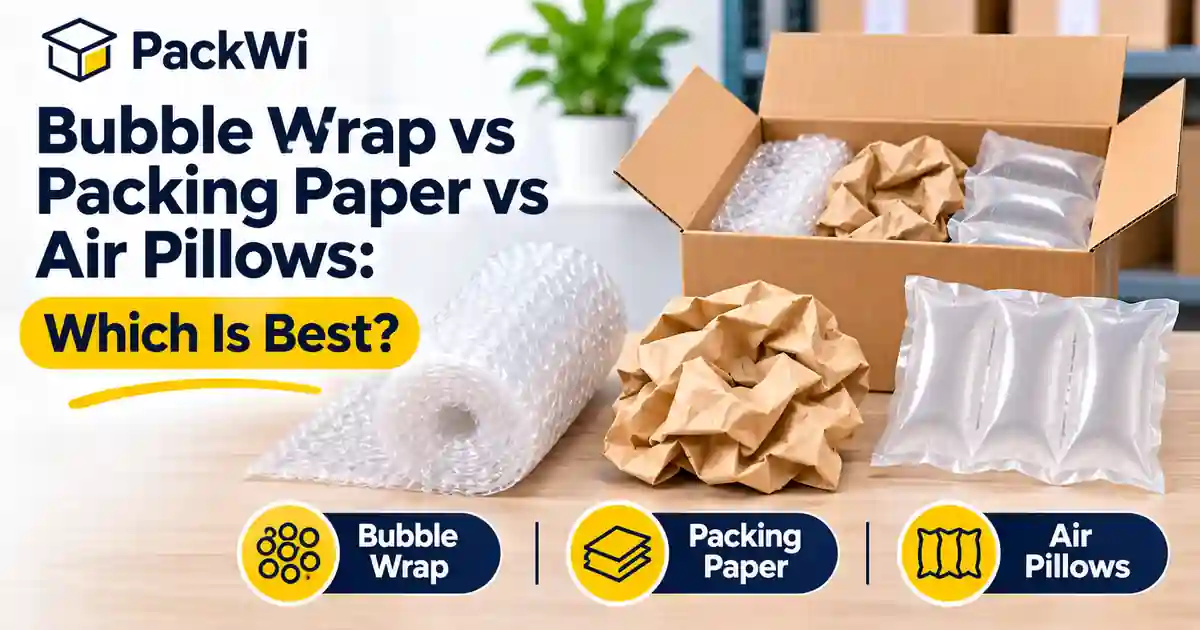

Choosing the right cushioning material can be just as important as choosing the right shipping box.
Bubble wrap, packing paper, and inflatable air pillows are three common options, but they don’t perform the same job.
Bubble wrap can cushion an item directly. Crumpled packing paper can help stabilize suitable products and fill empty spaces. Air pillows are often used to keep lightweight items from moving around inside a larger box.
So, when comparing bubble wrap vs packing paper vs air pillows, which material should you choose?
The answer depends on the product’s weight, fragility, shape, and the kind of protection it needs.
This guide compares the three materials, explains their limitations, and provides practical examples to help you pack different shipments more effectively.
The Three Jobs of Protective Packaging
Before comparing materials, it helps to understand what protective packaging is supposed to accomplish.
1. Cushioning
Cushioning helps absorb impacts and reduce the force transferred to an item.
This matters when a product can crack, chip, or suffer damage during normal transportation.
2. Void Filling
Void filling means occupying unnecessary empty spaces inside a shipping box.
Its main purpose is to limit movement.
A box may have enough protective material around an item but still allow it to slide if the remaining space is not properly filled.
3. Blocking and Bracing
Blocking and bracing help hold an item in position.
This is especially important for heavier products that may compress or shift ordinary loose packing materials.
One material does not necessarily perform all three jobs equally well.
For example, large air pillows may fill a gap effectively but provide little protection against concentrated pressure from a sharp metal component.
Bubble Wrap vs Packing Paper vs Air Pillows: Quick Comparison
| Feature | Bubble wrap | Packing paper | Air pillows |
|---|---|---|---|
| Main purpose | Cushioning and wrapping | Void filling and stabilization | Void filling for suitable lightweight items |
| Direct item wrapping | Often suitable | Suitable for some surfaces and products | Usually not the primary use |
| Protection from minor impacts | Can provide cushioning | Depends on amount and how it is packed | Depends on pillow design and application |
| Filling large empty spaces | Possible, but can use a lot of material | Often practical | Often practical |
| Sharp corners | May need additional protection | May need reinforcement | Generally unsuitable against sharp edges |
| Heavy items | Requires appropriate material and design | Can compress or shift | Standard lightweight pillows may be unsuitable |
| Storage | Usually stored in rolls or sheets | Often stored in rolls or sheets | Uninflated film can save storage space |
| Common mistake | Using too few layers | Leaving paper loosely crumpled | Assuming pillows replace product cushioning |
This table compares typical uses. Individual products vary by thickness, density, material grade, and manufacturer.
When Is Bubble Wrap the Better Choice?
Bubble wrap is an air-cellular cushioning material made from plastic film with sealed air pockets.
It is commonly used to wrap products and provide a protective layer between an item and its surroundings.
Suitable Uses for Bubble Wrap
Bubble wrap may be useful for:
- Ceramic accessories
- Small decorative objects
- Certain glass products
- Lightweight electronic accessories
- Products with vulnerable corners
- Items that need some impact cushioning
It can conform to different product shapes, making it useful when a rigid protective insert is unavailable.
However, its effectiveness depends on the item’s weight, the number of layers, and the bubble structure.
How to Use Bubble Wrap Properly
A practical approach is to:
- Inspect the item’s delicate surfaces and projecting parts.
- Use a suitable protective surface layer if the finish is sensitive.
- Wrap the item with enough bubble cushioning for its needs.
- Pay additional attention to corners and vulnerable edges.
- Secure the wrapping without attaching tape directly to the product.
- Place the wrapped item inside a strong outer box.
- Fill remaining spaces so the product cannot shift.
UPS recommends positioning the flat side of bubble wrap against the product, with the bubbles facing outward, when using it for direct wrapping.
You can find more material-specific recommendations in the UPS Packaging Tips.
Limitations of Bubble Wrap
Bubble wrap should not be treated as crush-proof packaging.
Under sufficient pressure, the bubbles can compress or fail.
A heavy or sharp object may require engineered foam, rigid inserts, stronger cardboard, or another protective system.
For sensitive electronics, follow the manufacturer’s requirements for static protection rather than assuming ordinary bubble wrap is appropriate.
When Should You Use Packing Paper?
Packing paper is commonly used to fill gaps and stabilize suitable products inside shipping boxes.
Kraft packing paper is especially common because it can be crumpled into a bulky filling material.
Its effectiveness depends heavily on how it is prepared.
Loosely Placed Paper vs. Crumpled Paper
Consider two packing methods.
In the first, someone places a few flat sheets of paper around a product.
The paper occupies little volume and may allow the item to shift.
In the second, the paper is properly crumpled and arranged around the product to provide support.
The second approach generally offers better stabilization for a suitable item.
The paper should be packed firmly enough to maintain its position without applying damaging pressure.
When Packing Paper Works Well
Packing paper can be useful for:
- Filling gaps around non-fragile products
- Preventing lightweight boxed products from sliding
- Separating suitable objects
- Adding a non-abrasive protective layer where appropriate
- Filling small spaces around securely wrapped items
UPS identifies tightly crumpled kraft paper as a void-fill option for lightweight, non-fragile goods and recommends maintaining appropriate separation between the contents and the outer box.
When Packing Paper Is Not Enough
Packing paper may not provide sufficient shock absorption for a fragile ceramic mug or delicate glass ornament.
Even if the box feels tightly packed, the paper can compress during transportation.
For fragile products, it may be better to combine paper with appropriate cushioning around each item.
Avoid using ink-printed newspaper directly against sensitive finishes or valuable surfaces because ink or contaminants may transfer.
What Are Air Pillows Best For?
Air pillows are inflatable plastic cushions, often supplied as connected sections or individual pockets.
They are mainly used to fill empty spaces around suitable products.
Because they contain air, they can occupy relatively large spaces while adding little packaging weight.
Some fulfillment operations use machines that inflate air pillows when needed, reducing the space required to store the uninflated film.
Suitable Uses for Air Pillows
Air pillows can be practical for:
- Lightweight products in retail cartons
- Non-fragile boxed accessories
- Suitable soft or durable merchandise
- Filling side gaps in larger shipping boxes
- Preventing lightweight packages from shifting
For example, imagine placing a small, sturdy retail box inside a larger corrugated shipping box.
If the product itself is already adequately protected, air pillows may be suitable for filling the remaining spaces.
Limitations of Air Pillows
Standard inflatable void-fill pillows are not ideal for items with sharp corners or edges that could puncture them.
They may also be unsuitable for heavy products that can crush or displace them.
UPS notes that extreme temperatures can affect the ability of inflatable packaging to provide adequate protection.
Different air-pillow products have different film strengths and intended uses, so the manufacturer’s specifications matter.
Do not assume that a box filled with air pillows is automatically protected against impacts or crushing.
Which Material Should You Use for Different Products?
The following table provides practical starting points.
| Product | Main shipping risk | Material worth considering |
|---|---|---|
| Ceramic mug | Cracking, broken handle, impact | Suitable bubble cushioning inside a strong box |
| Small durable retail-boxed accessory | Movement inside the shipping carton | Crumpled paper or suitable air pillows |
| Paperback book | Bent corners and cover damage | Rigid cardboard support, with paper to stabilize if needed |
| Folded T-shirt | Dirt, moisture exposure, and unnecessary bulk | Suitable mailer; cushioning may not be needed |
| Glass decoration | Impact, movement, crushing | Individual cushioning and possibly double boxing |
| Heavy metal component | Concentrated weight, sharp edges | Engineered supports and strong corrugated packaging |
| Lightweight household item | Shifting within a box | Paper or suitable air pillows, depending on shape |
These examples are general guidance. Final packaging should reflect the actual item’s dimensions, weight, and fragility.
For instance, a paperback may benefit more from rigid cardboard protection than from several layers of soft bubble wrap.
Likewise, a heavy metal component should not be suspended inside a box using only ordinary air pillows.
Example 1: Packing a Ceramic Mug
Suppose you’re shipping a ceramic coffee mug with a handle.
The main risks include:
- The handle breaking
- The mug striking the box walls
- Pressure from other items
- Insufficient protection at the bottom of the box
Suggested Packing Approach
Start with a sturdy box that offers adequate internal space.
Protect any sensitive finish, then wrap the mug with suitable cushioning, paying special attention to the handle.
Add cushioning to the bottom of the box before positioning the wrapped mug.
Fill remaining spaces so the item stays securely supported.
The protective materials should separate the mug from the outer box on every side.
For especially delicate or valuable items, consider a double-box arrangement.
FedEx’s guidance for breakable products discusses substantial cushioning and recommends approximately 3 inches of appropriate cushioning in certain fragile-item packing methods.
See FedEx’s guidance on packing breakables for further details.
Which Material Wins?
For this example, bubble cushioning is usually more useful as the primary protective wrap than loose paper or ordinary air pillows.
Packing paper may still help fill suitable gaps, but it should not replace necessary impact cushioning.
Example 2: Packing a Durable Retail-Boxed Product
Now imagine a small non-fragile accessory already enclosed in a sturdy retail package.
The retail box measures:
9 × 7 × 5 inches
The available shipping carton measures:
12 × 10 × 8 inches internally
The carton has a greater volume than the retail package.
Let’s calculate the difference.
| Measurement | Calculation | Volume |
|---|---|---|
| Shipping box | 12 × 10 × 8 | 960 cubic inches |
| Retail product box | 9 × 7 × 5 | 315 cubic inches |
| Geometric empty volume | 960 − 315 | 645 cubic inches |
The outer box has 645 cubic inches of geometric space not occupied by the product box.
This number is not a direct measurement of how much packing paper or how many air pillows to use.
It simply shows that a relatively large amount of space remains.
Two Possible Solutions
Option A: Use a smaller shipping box.
If a smaller box still provides appropriate protection, it may reduce the amount of filling material required.
Option B: Fill the available space.
For a suitably durable and lightweight product, crumpled packing paper or appropriately rated air pillows may help stabilize the retail package.
Which Material Wins?
In this situation, packing paper and air pillows can both be practical, depending on product weight, packing method, cost, and available supplies.
Bubble wrap may be unnecessary if the main problem is simply empty space around an already protected product.
For help selecting a better-fitting container, see our guide: How to Choose the Right Shipping Box Size.
Example 3: Shipping a Paperback Book
Suppose you’re mailing a paperback that needs protection from bending and corner damage.
None of the three materials in this comparison automatically solves the main problem.
Bubble wrap can add some cushioning.
Paper can help reduce movement.
Air pillows can fill spaces around a suitable package.
However, rigid cardboard protection is often more important for preventing bending.
A suitable rigid book mailer or cardboard-supported package should be the starting point.
Packing paper can then be used, where appropriate, to stabilize the protected book.
Which Material Wins?
The best solution may not be any one of these three materials by itself.
This is an important reminder that choosing the right packaging means identifying the main risk first.
Example 4: Shipping a Lightweight Boxed Accessory
Imagine you’re shipping a lightweight boxed household accessory.
Its retail packaging is strong enough for the product, but the outer shipping carton has a few inches of empty space around it.
The accessory is relatively durable and has no exposed sharp corners.
Possible Packing Approach
- Inspect the retail package for damage.
- Place it in a suitable shipping carton.
- Position it away from direct contact with the outer walls where protection is required.
- Fill the remaining spaces with suitable air pillows or crumpled paper.
- Check that the product doesn’t shift.
- Seal the box securely.
Which Material Wins?
Air pillows may be particularly convenient for this kind of lightweight void filling.
However, crumpled paper may work equally well for a small number of shipments, especially when air-pillow equipment is unavailable.
The better choice depends on the packing operation and the actual product.
Can You Combine Bubble Wrap and Packing Paper?
Yes. In many situations, combining materials is more effective than using one material for everything.
Consider a delicate decorative item.
You might:
- Protect its sensitive surface.
- Apply appropriate bubble cushioning around the item.
- Place it inside a sturdy shipping box.
- Use suitable packing paper or other materials to stabilize the wrapped product.
- Check the cushioning and closure.
Here, bubble wrap provides the primary cushioning around the object, while paper helps control movement.
These materials serve complementary purposes.
The amount and arrangement of protection should suit the item’s weight and fragility.
Which Packaging Material Is Cheapest?
There is no universal winner.
The total cost depends on several factors:
- Material price
- Quantity purchased
- Material used per package
- Storage requirements
- Time required for packing
- Equipment costs
- Shipping weight and package dimensions
- Product damage and replacement costs
Bubble Wrap Costs
Bubble wrap may require multiple layers around a fragile product.
It can be convenient for irregular shapes, but using large quantities just to fill empty spaces may be inefficient.
Packing Paper Costs
Paper is widely available and may be economical for smaller shipping operations.
However, it can take time to crumple and arrange properly.
The amount required also varies by product and box size.
Air Pillow Costs
On-demand inflation can reduce the amount of storage space needed for uninflated supplies.
However, the equipment and film costs may not make sense for every small shipping operation.
Compare the cost per safely packed shipment, not merely the cost per roll or sheet.
Which Is Better for the Environment?
Environmental comparisons are more complicated than simply choosing paper over plastic.
Factors include:
- How much material is used
- Whether the material contains recycled content
- Whether it can be reused
- Local collection and recycling options
- Material transportation and storage
- The amount of packaging waste created
- Whether the material adequately protects the product
Clean kraft paper may be accepted in paper recycling systems, depending on local rules.
Plastic bubble wrap and air-pillow film may require separate flexible-plastic collection where such programs exist.
Not every local recycling program accepts these materials.
The protective performance also matters.
If poor packaging allows a product to break and require replacement, the resulting waste can extend well beyond the packaging material itself.
Practical Ways to Reduce Waste
- Use the smallest box that can safely protect the product.
- Avoid adding cushioning that serves no clear purpose.
- Reuse suitable clean packing materials when they remain effective.
- Select appropriate materials for the actual item.
- Check local disposal and recycling guidance.
- Don’t sacrifice necessary protection solely to minimize material use.
How to Check Whether You’ve Used Enough Packing Material
A well-packed shipment should feel secure and close without forcing the outer box out of shape.
Before sealing, ask these questions:
Can the product shift?
If the item moves freely, it may need additional stabilization or a better-fitting box.
Is the product touching the outer cardboard?
For items requiring impact cushioning, avoid direct contact with the box walls.
Are there unsupported corners or projections?
Handles, sharp edges, and protruding parts may need special treatment.
Will the material stay in place?
Loose paper or poorly positioned air pillows may move during normal handling.
Does the box close naturally?
Bulging panels or flaps that resist closing may indicate poor fit or excessive filling.
Is the product adequately protected for its weight?
Heavy products may need stronger materials than lightweight void fill.
For particularly valuable or fragile items, consider packaging testing or specialist advice appropriate to the risk.
Common Mistakes When Choosing Packing Materials
Mistake 1: Treating Void Fill as Impact Protection
Filling an empty box does not automatically mean a fragile product has adequate cushioning.
Better approach: Identify the required protection before selecting the filling material.
Mistake 2: Using Air Pillows Around Sharp Items
A sharp edge can puncture an inflatable pillow and reduce its effectiveness.
Better approach: Protect the edge and use materials designed for the product’s weight and shape.
Mistake 3: Leaving Packing Paper Too Loose
Loosely placed sheets may not stop a product from moving.
Better approach: Use appropriately crumpled and positioned paper for suitable items.
Mistake 4: Using Too Little Bubble Wrap
A thin layer may not provide enough cushioning for a vulnerable item.
Better approach: Match the material thickness and number of layers to the item’s protection needs.
Mistake 5: Ignoring the Bottom of the Box
A product may be surrounded by filling material while resting directly on the bottom panel.
Better approach: Provide appropriate support beneath the product as well as around its sides and top.
Mistake 6: Assuming More Material Always Means Better Protection
An oversized box filled with random materials may be less efficient and less reliable than a correctly sized package.
Better approach: Start with good measurements and a suitable container.
Packing Material Selection Checklist
Before preparing a shipment, review these points:
- I know whether the product needs cushioning, void fill, or rigid support.
- The material is suitable for the item’s weight.
- Any sharp edges or vulnerable corners are protected.
- Fragile products have appropriate individual cushioning.
- Empty spaces are filled without creating excessive pressure.
- The contents cannot shift freely inside the package.
- The box is strong enough for the finished shipment.
- The package closes without bulging.
- The final outside dimensions and weight have been measured.
- The packaging meets the shipping carrier’s applicable requirements.
Frequently Asked Questions
Is bubble wrap better than packing paper?
Bubble wrap is often more useful for cushioning an item directly, while crumpled paper is often useful for filling spaces and stabilizing suitable lightweight goods. Neither is automatically better for every shipment.
Are air pillows good for fragile items?
Air pillows are primarily useful as void fill for suitable products. Standard lightweight air pillows should not be relied upon as the only protection for fragile, heavy, or sharp-edged items.
Can packing paper replace bubble wrap?
Sometimes, for relatively durable products that mainly need stabilization. For fragile products requiring impact cushioning, packing paper alone may not be adequate.
Should I put bubble wrap around the product or inside the box?
Depending on the product, bubble wrap may be used around the item and as cushioning inside the box. Protect fragile surfaces and ensure there is suitable protection between the product and the outer container.
Do air pillows reduce shipping weight?
Air pillows can be lightweight relative to some alternatives, but whether they reduce shipping charges depends on the finished package’s actual weight, dimensions, carrier, and service.
Is paper always more environmentally friendly than plastic air pillows?
Not necessarily. Material quantity, recycled content, reuse, local recycling systems, transportation, and product protection all affect environmental outcomes.
What should I use for heavy products?
Heavy items may require engineered foam, rigid inserts, strong corrugated packaging, or other bracing systems. Ordinary lightweight void-fill materials alone may not provide adequate protection.
Final Thoughts
When comparing bubble wrap vs packing paper vs air pillows, the most important question is not which material is universally best.
It is what kind of protection the shipment actually needs.
Bubble wrap can be useful for cushioning individual items.
Crumpled kraft paper can stabilize suitable products and fill empty spaces.
Air pillows can efficiently occupy gaps around appropriate lightweight merchandise.
For heavy, sharp, fragile, or easily crushed goods, additional protective materials or stronger packaging may be necessary.
Choose a correctly sized box, identify the product’s main risks, and use materials that work together rather than adding filling at random.
That approach can help you create more consistent packages while avoiding unnecessary material use.
Editorial note: The examples in this PackWi guide are illustrative packing scenarios, not results from laboratory drop tests. Carrier requirements, material specifications, and product protection needs vary. Follow the relevant carrier and packaging manufacturer’s instructions for your shipment.