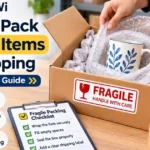
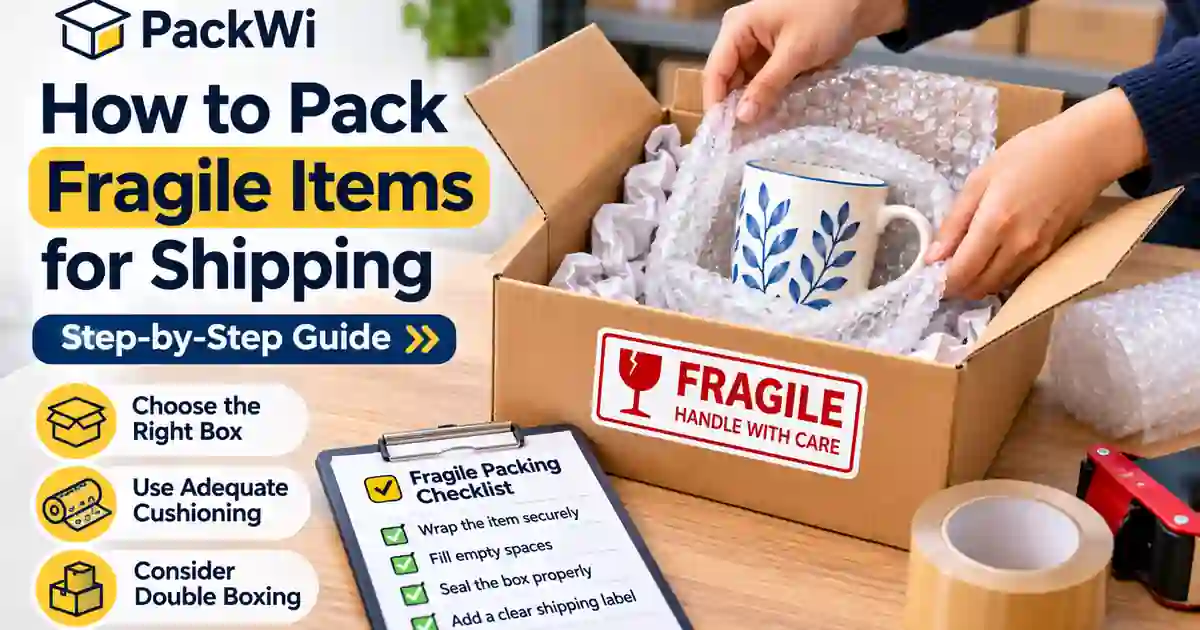

Fragile items need more than a cardboard box and a few pieces of bubble wrap. Whether you’re shipping a ceramic mug, a glass ornament, a framed picture, or a delicate collectible, the way you arrange and protect the contents can make a significant difference.
If you’re wondering how to pack fragile items for shipping, the most important principle is simple: protect the product from movement, impact, and pressure without creating an unnecessarily oversized package.
This step-by-step guide explains how to select packaging materials, cushion delicate objects, use the double-box method, and check a package before sending it.
You’ll also find a practical example for packing a ceramic mug, a comparison of cushioning materials, and a final checklist you can use for future shipments.
What Makes an Item Fragile During Shipping?
Fragility isn’t limited to glass.
A product may be vulnerable because it can crack, bend, scratch, chip, or lose its shape under pressure.
Common examples include:
- Glassware, bottles, and decorative ornaments
- Ceramic mugs, plates, and bowls
- Picture frames and mirrors
- Delicate collectibles and figurines
- Products with thin handles or projecting parts
- Certain electronic devices and accessories
- Decorative items with painted or polished surfaces
Different products can fail in different ways.
A ceramic mug might break when its handle strikes the side of a box. A framed print may be damaged if the package bends. A glass ornament could crack if it moves against another object.
That is why a suitable packing method must address the item’s particular weak points rather than simply filling the box with soft material.
Step 1: Inspect and Measure the Item
Before selecting packaging materials, examine the product.
Look for handles, narrow sections, sharp corners, delicate surfaces, and any components that move.
Then measure its maximum:
- Length
- Width
- Height
Include projecting parts such as handles or decorative features.
If the item has a removable component, consider whether it can be packed separately without risking damage.
For example, a ceramic mug’s handle may extend beyond the cylindrical body. Measuring only the body can lead you to choose a box that is too narrow.
Also consider the object’s weight. A heavy glass item requires cushioning that can support it without compressing excessively.
Protect surfaces before adding cushioning
For delicate finishes, painted surfaces, or polished products, place a suitable non-abrasive protective layer around the item before applying bubble cushioning.
This can help reduce surface rubbing.
Avoid placing adhesive tape directly on delicate products, as it may leave residue or damage the finish.
Step 2: Choose a Strong Shipping Box
For most breakable products, a rigid corrugated box is a more appropriate starting point than a flexible mailing envelope.
The box should be:
- Strong enough to support the product’s weight
- Free from crushed corners or damaged seams
- Large enough to accommodate protective cushioning
- Small enough to avoid unnecessary empty space
For heavy or especially delicate items, consider stronger corrugated cardboard or a double-wall box.
A previously used box may appear suitable but can have weakened corners or panels.
If you reuse packaging, check its condition carefully and remove all old shipping labels.
How much space should you leave?
The answer depends on the product, cushioning material, and carrier guidance.
As one useful reference, FedEx recommends substantial cushioning for breakable items, including approximately 3 inches of appropriate air-cellular cushioning for individually wrapped fragile products.
A suitable box needs enough usable internal space for that protective material.
However, cushioning thickness alone does not guarantee protection. The material must also support the product’s weight and prevent it from moving.
For a more detailed explanation of box measurements, read our guide: How to Choose the Right Shipping Box Size.
Step 3: Select the Right Cushioning Materials
Packaging materials have different protective properties.
Some absorb shocks, others prevent scratching, and others mainly fill empty spaces.
| Material | Useful purpose | Important limitation |
|---|---|---|
| Bubble wrap | Cushioning lightweight and delicate objects | Can compress and may not sufficiently protect heavy items |
| Foam sheets | Surface protection and cushioning | Thickness and density must suit the product |
| Molded foam inserts | Supporting a specific product shape | Usually designed for particular products |
| Crumpled kraft paper | Filling spaces and stabilizing suitable items | May compress under heavy loads |
| Packing peanuts | Filling spaces around lightweight objects | Can shift, allowing items to settle |
| Corrugated dividers | Separating items inside a box | Usually need additional cushioning |
| Air pillows | Filling spaces around certain lightweight items | Not ideal against sharp edges or heavy concentrated loads |
A useful packing method often combines materials rather than relying on just one.
For example, you might use a soft protective sleeve against a decorative surface, bubble wrap around the object, and sturdy paper or foam around the wrapped item.
The material arrangement should prevent direct contact between the product and the cardboard walls.
Step 4: Wrap Fragile Items Individually
When shipping multiple breakable objects in one package, don’t place them together unwrapped.
Each item should have its own protective layer.
A practical wrapping process is:
- Cover any sensitive surface with suitable protective material.
- Apply multiple layers of cushioning around the item.
- Reinforce vulnerable corners, handles, or protruding sections.
- Secure the wrapping without applying tape directly to the product.
- Check that the item cannot slip out of its protective covering.
For hollow items such as mugs or certain glass containers, suitable internal padding may provide additional protection.
However, don’t force too much material into a fragile cavity. Excessive pressure can also cause damage.
Why individual wrapping matters
Imagine two ceramic cups packed inside the same box.
Even if the outer walls are cushioned, the cups may still collide during transportation.
Wrapping and separating them helps protect the items from one another as well as from external impacts.
Step 5: Build a Cushioned Base
The bottom of the shipping box needs protection too.
Start by placing an appropriate cushioning layer in the bottom of the box before adding the wrapped product.
This layer helps separate the product from the outer cardboard surface.
Avoid placing a fragile item directly on the bottom panel and filling only the sides.
For heavier products, select cushioning that won’t easily collapse beneath the weight.
The goal is to maintain a protective space between the product and every outer surface.
Step 6: Position the Item in the Center
Place the individually wrapped product near the center of the box.
Fill the spaces around it with suitable cushioning so that it cannot slide toward the box walls.
Pay attention to all six directions:
- Bottom
- Top
- Left side
- Right side
- Front
- Back
Don’t leave a large empty pocket above the product.
If the box is turned upside down or placed on its side, the item should remain supported.
At the same time, don’t pack so tightly that the box bulges outward.
A box should close naturally and retain its intended shape.
Step 7: Use Double Boxing for Delicate Items
The double-box method adds a second layer of protection by placing one packed box inside a larger outer box.
This can be particularly useful for valuable, highly fragile, or difficult-to-replace products.
How double boxing works
- Wrap the fragile product with appropriate cushioning.
- Place it inside a sturdy inner box.
- Fill the remaining space so the product stays secure.
- Seal the inner box.
- Prepare a larger outer box with cushioning on the bottom.
- Center the sealed inner box inside the outer box.
- Fill the space around every side of the inner box.
- Seal the outer box securely.
FedEx’s breakable-item guidance recommends approximately 3 inches of cushioning in and around the inner box when double boxing fragile items.
A dimensional example
Suppose your packed inner box measures:
8 × 8 × 8 inches externally
To allow 3 inches of cushioning on all six sides, an outer box would need at least:
14 × 14 × 14 inches of usable internal space
The calculation is:
8 + 3 + 3 = 14 inches for each dimension.
This example illustrates the space allowance. The actual box selection depends on the item’s weight, the cushioning material, and the carrier’s requirements.
Double boxing can increase package size and shipping cost, so evaluate whether the added protection is appropriate for the product.
Step 8: Seal the Box Correctly
A well-packed product can still be exposed if the box opens during transportation.
Use appropriate shipping tape rather than household tape intended for light-duty tasks.
For a standard cardboard shipping box, the H-taping method is a practical way to reinforce the closure.
What is H-taping?
The tape forms an H-shaped pattern across the top and bottom closures.
Apply tape:
- Along the central seam where the top flaps meet
- Across one side edge
- Across the other side edge
Repeat as appropriate on the bottom.
Use tape wide and strong enough for the weight of the package.
Avoid using string or unsuitable household adhesive tape to secure the parcel.
Step 9: Label and Measure the Finished Package
Once the box is sealed, attach the shipping label to a suitable flat surface.
Keep the barcode clear, readable, and away from edges or seams whenever possible.
If you use a Fragile label, treat it as a handling request, not a substitute for protective packaging.
Packages may still pass through automated sorting systems and experience normal transport movement.
Before buying a shipping label:
- Measure the completed box’s exterior length, width, and height.
- Weigh the fully packed shipment.
- Review the shipping service’s packaging and size requirements.
- Check whether dimensional-weight pricing may apply.
A package containing a lightweight but delicate product can become relatively large after suitable cushioning is added.
Understanding dimensional weight can help you compare different safe packaging options.
Practical Example: How to Pack a Ceramic Mug
Let’s apply the steps to a common fragile product.
Imagine you’re shipping a ceramic coffee mug.
The mug has a projecting handle and a glossy finish. Both need attention.
Materials
Prepare:
- A sturdy corrugated shipping box
- Suitable protective paper or a soft sleeve
- Bubble wrap or another appropriate cushioning material
- Additional foam or paper for stabilization
- Strong packing tape
Packing method
1. Inspect the mug. Check for existing cracks, chips, and weak areas around the handle.
2. Protect the finish. Add a suitable non-abrasive layer if necessary.
3. Support the handle. Wrap and cushion the handle carefully so it is protected from impacts and not left as an exposed projection.
4. Wrap the entire mug. Add cushioning around the mug and its handle. Avoid relying on a single thin sheet.
5. Prepare the box. Add cushioning to the bottom.
6. Center the mug. Keep it separated from the cardboard walls.
7. Fill remaining spaces. Use suitable materials to stabilize the wrapped mug without crushing it.
8. Inspect the fit. Before sealing, check that the mug cannot shift and that the box closes without bulging.
For a particularly valuable or delicate mug, consider the double-box method.
What should you avoid?
Don’t place the bare handle against a cardboard wall.
Don’t rely on empty space to protect the mug.
And don’t pack another hard object beside it without appropriate separation.
This method does not guarantee that every mug will survive shipping, but it addresses several common sources of damage.
Packing Different Fragile Products
Fragile products require different types of protection.
| Product | Main risk | Packaging priority |
|---|---|---|
| Ceramic mug | Broken handle, cracks, chips | Protect projecting parts and restrict movement |
| Glass ornament | Impact and crushing | Individual cushioning and a strong outer box |
| Picture frame | Broken glass, bent frame corners | Corner protection and rigid support |
| Decorative plate | Edge chips and pressure | Separate cushioning and appropriate vertical support |
| Collectible figurine | Broken thin projections | Protect weak sections without direct pressure |
| Delicate electronics | Impact, static, or component damage | Manufacturer-approved packing and suitable anti-static materials |
Electronics and devices containing batteries may have additional transport restrictions. Check the carrier’s requirements before preparing them for shipment.
Similarly, glass containers holding liquids require attention to leakage and any applicable rules for the substance inside.
Common Mistakes When Packing Fragile Items
Mistake 1: Using a box that’s too small
The item fits, but there isn’t enough space for protective material.
Better approach: Choose the box after determining the total cushioning requirements.
Mistake 2: Filling a large box with loose materials
The contents may gradually sink or move as the filling shifts.
Better approach: Use cushioning and bracing that hold the item securely.
Mistake 3: Wrapping multiple items together
Fragile objects can strike each other inside a package.
Better approach: Wrap and separate items individually.
Mistake 4: Ignoring the bottom of the box
The product may receive cushioning on the sides but rest directly against the bottom panel.
Better approach: Build a protective base before placing the product inside.
Mistake 5: Assuming a Fragile sticker is enough
The label doesn’t replace a strong box, appropriate cushioning, or secure sealing.
Better approach: Pack the item to withstand normal handling regardless of the label.
Mistake 6: Reducing protection to save on shipping
A smaller box isn’t a good choice if it leaves the product exposed to damage.
Better approach: Prioritize adequate protection, then eliminate genuinely unnecessary space.
Single Box or Double Box: Which Should You Choose?
| Consideration | Single box | Double box |
|---|---|---|
| Suitable for | Products that can be adequately protected in one container | Especially delicate or valuable items needing additional isolation |
| Packaging materials | Usually fewer | Usually more |
| Package size | Often smaller | Often larger |
| Packing process | Simpler | More involved |
| Main requirement | Effective cushioning around the product | Effective cushioning inside and around the inner box |
Neither approach guarantees protection in every situation.
The correct choice depends on the item’s vulnerability, weight, packaging design, and shipping conditions.
Fragile Shipping Checklist
Before sealing and sending the parcel, confirm the following:
- The item has been inspected for damage.
- Any fragile corners, handles, and projecting parts are protected.
- The shipping box is strong enough for the contents.
- Appropriate cushioning surrounds the item.
- Multiple items are individually protected and separated.
- The contents cannot move freely inside the package.
- The box closes without bulging.
- All necessary seams are securely taped.
- Old labels have been removed or covered.
- The shipping label is clear and correctly attached.
- The completed package has been measured and weighed.
- Applicable carrier rules have been checked.
Keep this checklist handy when packing different types of fragile products.
Frequently Asked Questions
What is the best way to pack fragile items for shipping?
Use a sturdy box, wrap each item individually, provide suitable cushioning around all sides, prevent movement, and seal the package securely. Highly delicate items may benefit from double boxing.
How much bubble wrap should I use for fragile items?
There is no universal amount for every product. It depends on the item’s fragility, weight, and the cushioning material. FedEx recommends substantial cushioning for breakables, including approximately 3 inches in its general fragile-item guidance.
Is bubble wrap enough for shipping glass?
Not always. Bubble wrap can provide cushioning, but glass may also need a rigid shipping box, appropriate separation, and additional protection against crushing and movement.
Should fragile items be shipped in a bubble mailer?
Generally, items vulnerable to crushing, bending, or breaking are better protected in a suitably cushioned rigid box. A padded mailer offers limited protection and is more suitable for appropriate lightweight, relatively durable products.
Does writing Fragile on a package prevent damage?
No. A Fragile label may communicate a handling request, but the package still needs to withstand normal shipping and sorting conditions.
Is double boxing necessary for every fragile item?
No. Double boxing is useful for certain delicate or valuable products, but a properly designed single-box package may be adequate for other items.
Can I reuse a cardboard box for fragile shipping?
Sometimes, provided the box is strong, clean, undamaged, and suitable for the contents. Avoid boxes with crushed corners, weakened seams, or moisture damage.
Final Thoughts
Learning how to pack fragile items for shipping is mainly about managing three risks: movement, impact, and pressure.
Start by identifying the item’s weak points. Choose a strong box, use cushioning suited to the object’s weight and fragility, and prevent it from contacting the container walls or other products.
For highly delicate shipments, consider double boxing with adequate space between the inner and outer containers.
Finally, seal the package securely and confirm the shipping requirements before sending it.
Good packaging doesn’t eliminate every risk, but a careful, repeatable process can help reduce avoidable packing mistakes.
For more guidance, explore PackWi’s Packaging Guides and Box & Mailer Sizes sections.
Sources and Further Reading
- FedEx — How to Pack Breakables
- UPS — Packaging Tips
- USPS — How to Prepare and Send a Package
- USPS — Packaging Pointers
PackWi provides general packaging information for educational purposes. Packaging needs and carrier requirements vary by item, service, and destination. Always check the relevant carrier’s instructions before shipping delicate or restricted goods.