
A poly mailer can be a practical way to ship clothing, but choosing the wrong size creates problems. A bag that’s too small may put stress on the seams, while an oversized bag can use unnecessary material and make the finished package harder to handle.
This poly mailer size guide helps you choose suitable packaging for T-shirts, jeans, sweaters, hoodies, jackets, and other soft goods.
You’ll learn how to measure clothing after folding, understand common mailer dimensions, and estimate how much space a garment needs once its thickness is considered.
The guide also includes a size chart, three worked examples, and a packing checklist you can use before ordering mailers.
What Is a Poly Mailer?
A poly mailer is a flexible shipping envelope, commonly made from polyethylene film.
Most everyday poly mailers have a self-sealing adhesive flap and are designed to carry suitable lightweight, non-fragile products.
They are frequently used for clothing because fabric can often be folded into a compact shape without requiring the rigid protection of a shipping box.
Typical products that may be suitable include:
- T-shirts and lightweight tops
- Leggings and soft trousers
- Socks and scarves
- Jeans and casual clothing
- Certain sweaters and hoodies
- Small bundles of soft accessories
Poly mailers are lightweight, but they don’t provide much cushioning or crush resistance.
For this reason, they’re not the best choice for every product. Clothing with delicate embellishments, rigid components, or easily damaged structures may need a protective box instead.
Poly Mailer Size Chart for Clothing
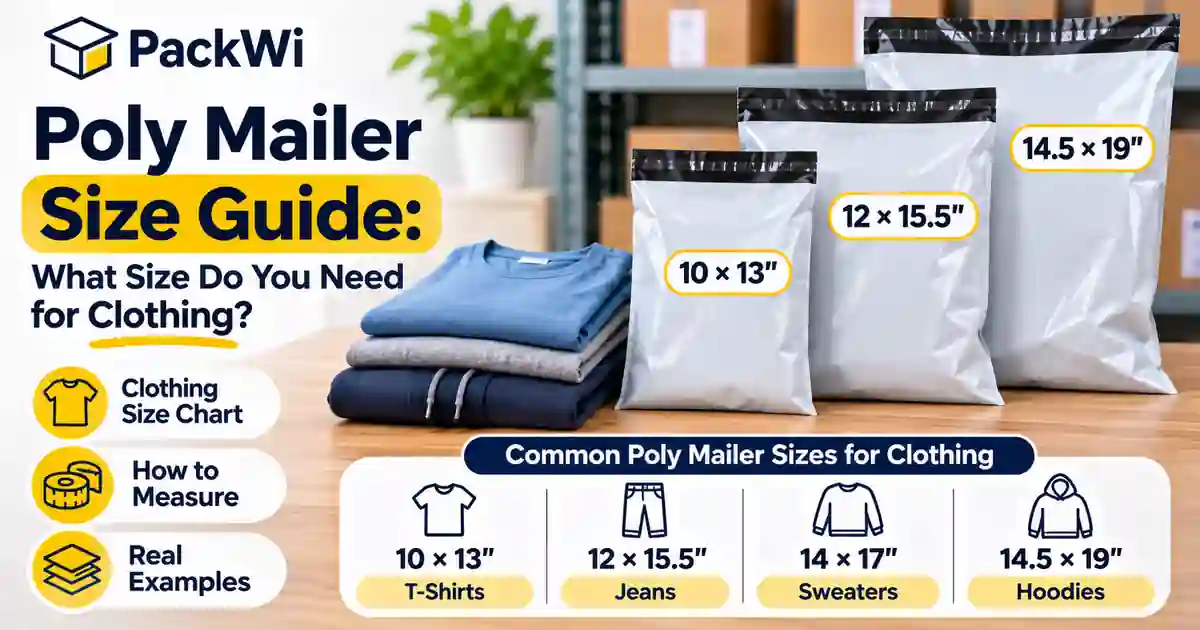
Poly mailers are commonly sold in measurements such as 6 × 9, 10 × 13, and 14.5 × 19 inches.
The following chart provides a useful starting point for comparing common sizes.
| Nominal mailer size (W × L) | Approximate metric size | Clothing or products to evaluate |
|---|---|---|
| 6 × 9 inches | 15.2 × 22.9 cm | Socks, underwear, small soft accessories |
| 7.5 × 10.5 inches | 19.1 × 26.7 cm | Baby clothing, small lightweight garments |
| 9 × 12 inches | 22.9 × 30.5 cm | Compact T-shirts, leggings, thin tops |
| 10 × 13 inches | 25.4 × 33 cm | Adult T-shirts, blouses, lightweight shirts |
| 12 × 15.5 inches | 30.5 × 39.4 cm | Jeans, sweaters, small clothing bundles |
| 14 × 17 inches | 35.6 × 43.2 cm | Heavier sweatshirts, medium apparel bundles |
| 14.5 × 19 inches | 36.8 × 48.3 cm | Hoodies, light jackets, bulky clothing |
| 19 × 24 inches | 48.3 × 61 cm | Larger soft-goods orders and bulky bundles |
Important: These are common nominal sizes, not guaranteed usable inside dimensions. The listed uses are starting suggestions, not promises that a particular garment will fit.
Measurements and construction can vary between manufacturers. Always check whether a supplier lists exterior dimensions, bag-body dimensions, or a measurement that includes the flap.
The sizes above are consistent with options in Uline’s polyethylene mailer range.
How to Measure Clothing for a Poly Mailer
The most reliable way to choose a poly mailer is to measure the item after it has been folded for shipping.
An unfolded T-shirt might be 20 inches wide, but its folded shipping bundle could be less than half that width.
You need three measurements:
Folded width: The distance across the shorter face of the folded clothing.
Folded length: The longer face dimension of the folded bundle.
Bundle thickness: The height of the folded clothing when it rests naturally on a flat surface.
Step 1: Fold the Garment
Use the same folding method you plan to use when preparing the actual shipment.
For example, a T-shirt can be folded by placing it face down, folding the sleeves inward, and then folding the body into a compact rectangle.
For jeans, fold the legs together and then fold the garment into a shorter bundle.
Avoid compressing clothing so tightly that it causes damage or puts unnecessary strain on the packaging.
Step 2: Include Any Inner Packaging
If you use tissue paper, a protective bag, a card insert, or another suitable protective layer, include it before measuring.
The measurements should describe the complete bundle that will enter the poly mailer, not just the bare garment.
Step 3: Measure the Thickness
This is one of the most frequently overlooked details.
A 10 × 13-inch flat mailer does not necessarily fit a rigid bundle that measures exactly 10 × 13 inches.
A flexible bag must wrap around the item’s thickness, which consumes some of its usable width and length.
A thick hoodie can therefore need a much larger mailer than a thin shirt with similar folded face measurements.
A Practical Way to Estimate Poly Mailer Size
For a flat, non-gusseted poly mailer, you can use this approximate planning method:
Estimated mailer width = Folded width + Bundle thickness + 0.5 inch
Estimated mailer length = Folded length + Bundle thickness + 1 inch
The additional allowance provides some working room for the package’s shape and closure.
This is a packing estimate, not a universal manufacturer standard or guarantee of fit.
Some mailers need more room due to their side seams, flap design, material stiffness, or how their dimensions are reported.
Use the result to shortlist available mailers, then test the actual packaged item before purchasing large quantities.
Example 1: Choosing a Poly Mailer for One T-Shirt
Imagine you’re shipping one lightweight adult T-shirt.
After folding it and adding a thin protective layer, the bundle measures:
| Measurement | Size |
|---|---|
| Folded width | 8.5 inches |
| Folded length | 10.5 inches |
| Thickness | 0.75 inch |
Using the estimate:
Width: 8.5 + 0.75 + 0.5 = 9.75 inches
Length: 10.5 + 0.75 + 1 = 12.25 inches
A 10 × 13-inch poly mailer is a reasonable first size to test.
The mailer should accommodate the folded shirt without stretching, and the adhesive flap should close naturally.
If the supplier’s actual usable area is smaller than expected, select the next suitable size.
Why Not Automatically Choose 9 × 12?
A 9 × 12-inch mailer may work for some very compact shirts.
However, the example bundle above requires more space under the planning estimate.
The better choice is the smallest mailer that fits the actual bundle without stressing the seams or closure.
Example 2: Choosing a Poly Mailer for Jeans
Jeans are heavier and usually thicker than a basic T-shirt.
Suppose a folded pair of jeans measures:
- Width: 9.5 inches
- Length: 11.5 inches
- Thickness: 2 inches
The estimated size becomes:
Width: 9.5 + 2 + 0.5 = 12 inches
Length: 11.5 + 2 + 1 = 14.5 inches
A 12 × 15.5-inch poly mailer is a possible starting point.
However, the estimated width leaves little extra clearance. If the filled mailer strains at the seams, a larger or expansion-style mailer may be more suitable.
Watch Out for Metal Hardware
Jeans often contain buttons, zippers, and rivets.
Fold the garment so that hard points don’t press directly against the mailer’s film whenever practical.
Suitable inner protection may also help prevent sharp hardware from rubbing against the outer bag.
Example 3: Choosing a Poly Mailer for a Hoodie
A hoodie creates a different sizing challenge because of its bulk.
Imagine a folded hoodie measuring:
| Measurement | Size |
|---|---|
| Folded width | 10.5 inches |
| Folded length | 12.5 inches |
| Thickness | 2.5 inches |
The estimate gives:
Width: 10.5 + 2.5 + 0.5 = 13.5 inches
Length: 12.5 + 2.5 + 1 = 16 inches
A 14.5 × 19-inch poly mailer is a sensible size to evaluate.
A smaller 12 × 15.5-inch bag is unlikely to provide enough room for the bundle in this example.
But hoodie thickness varies considerably.
A lightweight hoodie might fit in a smaller mailer, while a heavy fleece hoodie may need more space or a gusseted option.
Always test the finished bundle.
Which Poly Mailer Size Is Best for Different Clothes?
T-Shirts and Lightweight Tops
For a single lightweight shirt, begin by testing either 9 × 12 inches or 10 × 13 inches.
The best fit depends on garment size, fabric thickness, folding method, and any included inserts.
Larger adult sizes or thicker cotton fabrics often require more room than compact lightweight tops.
Jeans and Trousers
A 12 × 15.5-inch mailer is a useful starting point for one pair of jeans.
Heavy denim, larger waist sizes, and thick folded sections may require more space.
Do not choose based on the clothing label alone.
Sweaters and Sweatshirts
A thin sweater may fit inside a 12 × 15.5-inch mailer.
Thicker knitwear or fleece sweatshirts may need a 14 × 17-inch or 14.5 × 19-inch option.
Consider how the garment naturally folds and whether the package can close without excessive compression.
Hoodies
Hoodies often need larger packaging because the hood, sleeves, and fleece lining increase bundle thickness.
A 14.5 × 19-inch mailer is a useful starting point for a bulky hoodie.
If it doesn’t fit comfortably, consider a gusseted mailer or an appropriate box.
Jackets and Structured Clothing
Some lightweight jackets may fit in a large poly mailer.
However, structured shoulders, padding, decorative details, or delicate fabrics can make a rigid box preferable.
For high-value formal clothing, protection against crushing and creasing may be more important than saving packaging space.
Flat Poly Mailers vs. Expansion Poly Mailers
Not every poly mailer has the same construction.
Flat Poly Mailers
Flat mailers have two main faces joined at the sides.
They are useful for compact, relatively thin products.
As the contents become thicker, the bag must wrap around the bundle, reducing available face space.
Expansion Poly Mailers
Expansion mailers include additional material, such as a gusset, to accommodate bulkier products.
They may work better for:
- Thick sweaters
- Bulky hoodies
- Multi-item clothing orders
- Certain larger soft goods
For example, some suppliers offer expansion mailers with dimensions such as 11 × 13 × 4 inches or 13 × 16 × 4 inches.
In these specifications, the third measurement describes the expansion depth.
An expansion mailer is not automatically better, but it can be more practical than using a very large flat bag for a thick bundle.
Poly Mailer vs. Bubble Mailer: What’s the Difference?
These packaging types are easy to confuse.
A standard poly mailer is a flexible bag without built-in bubble cushioning.
A bubble mailer contains a padded lining intended to provide some protection against minor impacts and rubbing.
| Feature | Poly mailer | Bubble mailer |
|---|---|---|
| Built-in cushioning | Usually none | Bubble lining |
| Typical use | Soft, durable goods | Suitable lightweight items needing limited padding |
| Thickness when empty | Usually very thin | Thicker due to padding |
| Protection against crushing | Very limited | Still limited |
| Common clothing use | Often appropriate | Usually unnecessary for basic soft garments |
A bubble mailer can provide some cushioning, but neither type is a replacement for a strong shipping box when the contents need rigid protection.
For example, a cotton T-shirt may be suitable for a poly mailer, while a ceramic mug usually needs a protective box.
When Should You Use a Shipping Box Instead?
Poly mailers can be practical for soft goods, but a box is often the safer choice when:
- The clothing has fragile decorations or beads.
- The item must retain a particular shape.
- The order contains several bulky products.
- There are sharp or rigid components inside the shipment.
- The item could be damaged by compression.
- The carrier requires stronger protective packaging.
UPS and FedEx both discuss poly mailers as possible packaging for suitable clothing while recommending boxes for certain bulkier, multiple-item, or delicate shipments.
For help choosing a correctly sized cardboard container, read PackWi’s guide: How to Choose the Right Shipping Box Size.
Does a Smaller Poly Mailer Reduce Shipping Costs?
It can help, but the answer depends on how the shipping company calculates charges.
Shipping prices may consider factors such as:
- Actual package weight
- Package dimensions
- Shipping distance
- Service type
- Carrier-specific pricing rules
- Additional charges
A smaller mailer can reduce unnecessary packaging material and may make the parcel more compact.
However, the smallest mailer does not always produce the lowest shipping price.
For example, a flexible parcel may be measured differently from a rigid box under some carrier services.
Always use the final package’s actual measurements and weight when comparing shipping options.
How to Pack Clothing in a Poly Mailer
Choosing the correct size is only part of preparing a shipment.
1. Prepare the Clothing
Make sure the garment is clean and dry.
Fold it neatly on a clean surface.
Protect delicate buttons, zippers, or decorations if necessary.
2. Add Suitable Inner Protection
Depending on the product, tissue paper or another appropriate inner protective layer may help keep the item clean and reduce rubbing.
Avoid adding unnecessary materials that make the package excessively bulky.
3. Insert the Folded Bundle
Slide the clothing into the mailer without forcing it.
If the side seams visibly stretch or the contents become distorted, try a larger size.
4. Seal the Flap Securely
Use the mailer’s adhesive closure according to the manufacturer’s instructions.
Make sure the closure area is clean, dry, and free from the garment itself.
Avoid sealing over loose fabric.
5. Check the Package
The package should be securely closed without gaps.
Look for sharp pressure points, stretched corners, or areas where the film could tear.
6. Attach the Shipping Label
Place the label on a flat, readable part of the package.
Avoid folds that obscure the barcode or address information.
Check the carrier’s packaging requirements before dispatch.
Five Common Poly Mailer Sizing Mistakes
Mistake 1: Choosing Based on Clothing Size Labels
A medium hoodie and a medium T-shirt can have very different folded dimensions.
Better approach: Measure the actual folded bundle.
Mistake 2: Ignoring Thickness
A thick item consumes more of a flat mailer’s usable space.
Better approach: Record width, length, and thickness before choosing packaging.
Mistake 3: Forgetting the Adhesive Flap
A garment may appear to fit but prevent the flap from closing properly.
Better approach: Leave enough clearance for the adhesive closure.
Mistake 4: Using a Flexible Bag for a Fragile Product
Poly mailers don’t provide meaningful crush protection.
Better approach: Choose a protective shipping box when the product needs rigid support.
Mistake 5: Ordering Hundreds of Mailers Without Testing
Nominal dimensions do not always reflect the exact usable space.
Better approach: Test a few real shipments before committing to bulk packaging.
A Practical Poly Mailer Inventory Plan
If you’re shipping several different clothing products, you don’t necessarily need every available mailer size.
A simple starting inventory might include:
| Mailer size | Purpose |
|---|---|
| 6 × 9 in | Small soft accessories |
| 10 × 13 in | Standard lightweight clothing orders |
| 12 × 15.5 in | Jeans, thicker garments, small bundles |
| 14.5 × 19 in | Bulky apparel and hoodies |
These four sizes cover different needs, but they won’t be suitable for every business or product range.
Before purchasing large quantities, pack representative samples from your actual clothing assortment.
Record which mailer closes securely without excessive spare material.
If many of your products fall between two standard sizes, consider testing another size or an expansion-style mailer.
Poly Mailer Packing Checklist
Before shipping clothing, verify the following:
- The garment is clean and completely dry.
- It has been folded into its final shipping shape.
- The folded width, length, and thickness have been measured.
- The selected mailer has enough usable internal space.
- The side seams are not stretched.
- Any hard components are appropriately protected.
- The adhesive flap closes without tension.
- The packaging is suitable for the product’s protection needs.
- The shipping label is readable.
- The completed shipment meets the carrier’s requirements.
Frequently Asked Questions
What is the best poly mailer size for a T-shirt?
A 10 × 13-inch poly mailer is a practical starting point for many folded adult T-shirts. Smaller shirts may fit in 9 × 12 inches. Measure the actual folded bundle before deciding.
Will jeans fit in a 10 × 13-inch poly mailer?
Some thin or compactly folded jeans might fit, but many pairs need more room. A 12 × 15.5-inch mailer is a useful size to test for typical jeans.
What size poly mailer should I use for a hoodie?
A 14.5 × 19-inch mailer is a reasonable starting option for many bulky hoodies. Thin hoodies may fit smaller mailers, while very thick garments may require expansion packaging or a box.
Are poly mailers waterproof?
Many polyethylene mailers are water-resistant, but that doesn’t mean every sealed package is completely waterproof. Water may enter through damaged film, seams, or an improperly closed flap.
Can I reuse a poly mailer?
Sometimes, if the material and closure remain strong enough for another shipment. A damaged adhesive flap or torn film can make reuse unsuitable. Reusable or double-seal mailers may be more practical for returns.
Are poly mailers cheaper than cardboard boxes?
They often use less material and are lighter, but total costs depend on the mailer, box alternative, order quantity, packing time, and shipping service.
Do I need bubble wrap inside a poly mailer for clothing?
Usually not for basic soft, non-fragile garments. However, the correct protective materials depend on the item. If the product needs substantial cushioning or crush resistance, a box may be more appropriate.
Do poly mailer dimensions include the flap?
Measurement conventions differ between suppliers. Confirm whether the advertised measurements describe the bag body, outside dimensions, or include any closure allowance.
Final Thoughts
Choosing a poly mailer is easier when you start with the garment’s folded width, length, and thickness rather than its clothing size label.
Use a size chart to shortlist possible bags, leave enough room for closure, and test the finished bundle.
A 10 × 13-inch mailer may work well for a lightweight shirt, while jeans and bulkier clothing often need more space.
The goal is to select packaging that fits comfortably, keeps the contents secure, and avoids unnecessary material use.
When a garment needs stronger protection, choose a suitable shipping box instead of forcing it into a flexible mailer.
For more practical packaging information, explore PackWi’s Box & Mailer Sizes and Packaging Guides sections.
Sizing note: The examples and calculations in this guide are educational estimates, not results from physical product testing. Actual fit depends on the mailer manufacturer, material construction, folded item, and closure design. Check the supplier’s specifications and applicable carrier requirements before shipping.