
Choosing the right poly mailer size can make clothing shipments easier to pack, protect garments during delivery, and reduce unnecessary packaging waste. However, selecting a mailer based only on the clothing size printed on a label—such as medium, large, or extra-large—often leads to disappointing results.
A folded cotton T-shirt, a thick hoodie, and a pair of jeans may all have similar widths but very different packed thicknesses. That difference matters when choosing a shipping bag.
In this guide, we’ll explain common poly mailer sizes for clothing, show how to measure folded garments, and walk through practical examples to help you choose a bag that fits without stretching or wasting space.
What Size Poly Mailer Do You Need for Clothing?
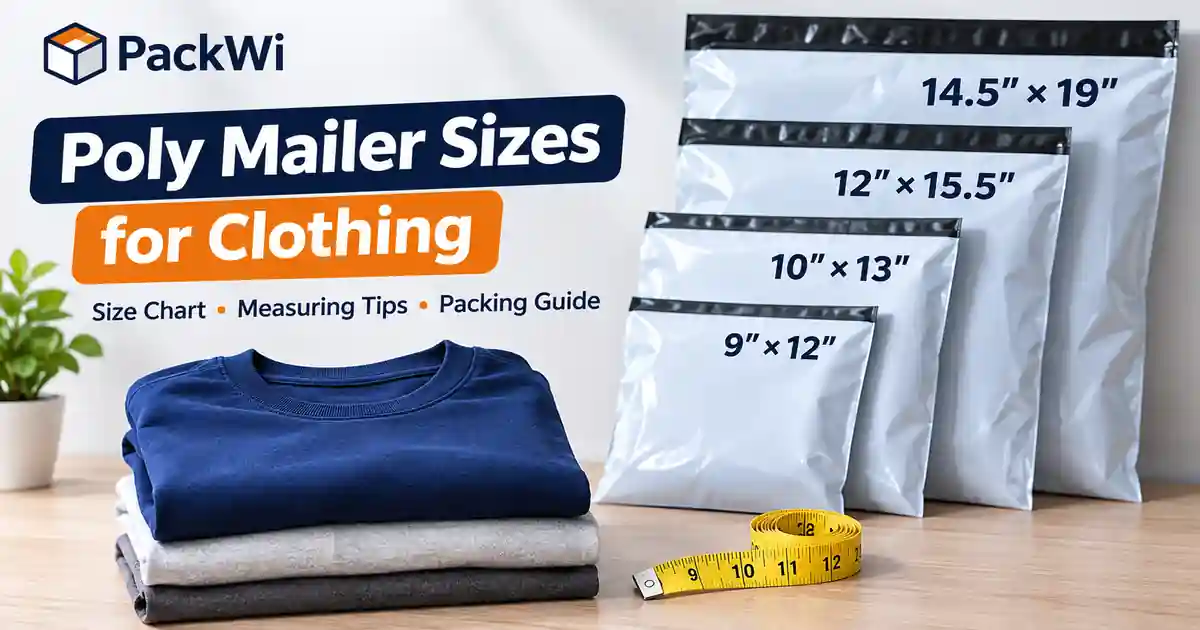
A 10 × 13-inch poly mailer is a useful starting point for many lightweight, folded T-shirts and similar garments. Thicker clothing, such as sweaters, jeans, and hoodies, may need larger mailers.
However, the best size depends on three measurements:
- The width of the garment after folding.
- The length of the folded garment.
- The thickness of the complete packed bundle.
The third measurement is especially important. A mailer that seems large enough when lying flat may become too tight once you insert a thick garment.
Always measure the product in its actual shipping configuration rather than relying on clothing labels or general size recommendations.
Poly Mailer Size Chart for Clothing
The following chart provides practical starting sizes for common clothing shipments.
| Poly Mailer Size (inches) | Approx. Size (cm) | Clothing to Test |
|---|---|---|
| 6 × 9 | 15 × 23 | Socks, small textile accessories |
| 9 × 12 | 23 × 30 | Compact, lightweight folded tops |
| 10 × 13 | 25 × 33 | T-shirts, leggings, light apparel |
| 12 × 15.5 | 30 × 39 | Jeans, lightweight sweaters, larger folded tops |
| 14.5 × 19 | 37 × 48 | Hoodies, thick sweaters, small clothing bundles |
| 19 × 24 | 48 × 61 | Large soft goods, jackets, multiple garments |
Important: These are common example sizes, not guaranteed fits. Manufacturers may measure mailers differently, and the amount of usable space depends on construction, seams, and the closure flap.
For example, a thin summer T-shirt might fit comfortably inside a 10 × 13-inch mailer, while a heavy cotton T-shirt of the same clothing size could require a larger bag.
How to Measure Clothing for a Poly Mailer
Correct measurements begin before you choose the envelope.
Step 1: Fold the Garment as You Will Ship It
Place the clothing on a clean surface and fold it using your normal packing method.
If you plan to include tissue paper, an inner protective bag, or a care card, add those materials before measuring.
Your goal is to measure the finished bundle, not just the garment.
Step 2: Measure the Width and Length
Use a measuring tape to record the width and length of the folded bundle.
Measure the widest points rather than the narrowest areas.
For irregular folds, smooth the fabric gently without compressing it excessively.
Step 3: Measure the Thickness
Place the folded clothing on a flat surface and measure how high the bundle stands.
A thin T-shirt might have a relatively small packed thickness, while a fleece hoodie could be several inches thick.
Thickness affects how much of the mailer’s flat width and length is used when it wraps around the product.
Step 4: Estimate the Required Mailer Size
For a basic flat poly mailer, the following working formula can help you select a starting size:
Estimated minimum width = folded width + thickness + 1 inch
Estimated minimum length = folded length + thickness + 2 inches
The extra room allows for easier insertion and closure.
This formula is a practical estimate, not a universal packaging standard. The usable dimensions and flap allowances vary by manufacturer.
Example: Choosing a Poly Mailer for a T-Shirt
Imagine you have a folded T-shirt with these measurements:
| Measurement | Size |
|---|---|
| Folded width | 8 inches |
| Folded length | 10 inches |
| Thickness | 0.5 inches |
Calculate the estimated minimum mailer size:
Width: 8 + 0.5 + 1 = 9.5 inches
Length: 10 + 0.5 + 2 = 12.5 inches
A 10 × 13-inch poly mailer would be a reasonable size to test.
Before purchasing a large quantity, insert the actual packed T-shirt and confirm that the adhesive flap closes securely without pulling against the fabric.
Example: Choosing a Mailer for a Thick Sweater
Now consider a folded sweater measuring:
- Width: 11 inches
- Length: 13 inches
- Thickness: 2.5 inches
Estimated minimum width:
11 + 2.5 + 1 = 14.5 inches
Estimated minimum length:
13 + 2.5 + 2 = 17.5 inches
A 14.5 × 19-inch mailer may be suitable, but the width is right at the estimated minimum. You should test the bag and choose a larger size if the seams are under tension.
This example shows why thicker products often require larger packaging, even when their folded surface dimensions look manageable.
Which Poly Mailer Size Works Best for Different Clothing?
T-Shirts and Lightweight Tops
A 10 × 13-inch mailer is a practical starting point for a single lightweight T-shirt.
Compact folds may fit smaller mailers, while oversized garments or multiple shirts may require larger ones.
Avoid forcing the fabric into an undersized bag simply to use less packaging.
Jeans and Trousers
Jeans generally produce a thicker folded bundle than lightweight shirts.
A 12 × 15.5-inch mailer may be worth testing, but thick denim, large sizes, and multiple pairs can require substantially more space.
Pay attention to the waistband, pockets, and folded seams, which may create uneven thickness.
Hoodies and Sweatshirts
Hoodies can be challenging because the hood, sleeves, and waistband often overlap.
For many bulky garments, a 14.5 × 19-inch mailer offers a more practical starting point than a small apparel envelope.
However, a thick hoodie may still require a larger bag or a box.
Socks, Scarves, and Small Accessories
Small flexible textile products may fit inside compact mailers such as 6 × 9 inches.
Nevertheless, the bag must have sufficient room for the complete order and a securely closed flap.
Multi-Item Clothing Orders
When shipping several garments together, measure the entire stacked bundle.
Three folded T-shirts do not necessarily need three separate mailers. They may fit in one larger envelope, provided the contents remain protected and the package closes properly.
A larger mailer is not automatically better. Choose the smallest suitable size that allows secure packing.
Poly Mailer vs. Bubble Mailer vs. Shipping Box
Choosing the right size is only part of the packaging decision. You also need the correct type of packaging.
| Packaging Type | Best Starting Use | Main Limitation |
|---|---|---|
| Poly mailer | Soft, flexible clothing | Little impact or crush protection |
| Bubble mailer | Small items needing light cushioning | Not a replacement for a rigid box |
| Corrugated shipping box | Fragile, rigid, or crush-sensitive products | May add weight and volume |
Poly mailers work well for many fabric products because clothing can tolerate some compression.
However, they are not ideal for items that need rigid support, including fragile accessories, breakable merchandise, or products with delicate structures.
If a clothing order includes a glass perfume bottle, for example, you should not assume that a standard poly mailer provides enough protection.
Choose packaging based on the needs of the complete shipment.
Can Poly Mailer Size Affect Shipping Costs?
Yes, although the result depends on the shipping service and how the carrier measures and prices the package.
Shipping charges may be influenced by:
- Actual package weight.
- Finished package dimensions.
- Package shape and handling requirements.
- Destination and service level.
- Carrier-specific pricing rules.
A lightweight poly mailer may use less packaging material than a cardboard box, but it does not guarantee a lower shipping price.
Importantly, the dimensions printed on an empty mailer are not necessarily the dimensions of the completed package.
If you are comparing a poly mailer with a rectangular shipping box, you can use PackWi’s Dimensional Weight Calculator to estimate the box’s dimensional weight using its outside dimensions.
Remember that actual carrier charges may follow additional rules, especially for irregular or flexible packages.
Five Mistakes to Avoid When Choosing Poly Mailer Sizes
1. Measuring Clothing Before Folding
The unfolded dimensions of a garment are rarely useful for selecting a shipping envelope.
Measure the folded and packed bundle instead.
2. Ignoring Thickness
This is one of the most common reasons a seemingly suitable mailer turns out to be too small.
A thick sweatshirt uses more of the available flat width than a thin T-shirt.
3. Forgetting the Closure Flap
The adhesive area must close securely.
Do not assume that a bag with the same listed length as your product will leave enough room for sealing.
4. Buying in Bulk Without Testing
A size chart is helpful, but physical samples are more reliable.
Test a few actual shipments before purchasing hundreds of mailers.
5. Using Poly Mailers for Every Product
Soft mailers are designed for particular packaging needs. They should not replace protective boxes when contents require structural support.
A Simple Three-Order Test Before Buying Mailers in Bulk
If you operate an online clothing store, you can reduce packaging mistakes by performing a basic fit test.
Test 1: Your smallest typical order
Pack a single lightweight item and confirm that the mailer does not leave excessive unused space.
Test 2: Your most common order
Use your normal order combination, including tissue paper, inserts, and any inner packaging.
Check how easily the product enters the mailer and whether the flap seals flat.
Test 3: Your bulkiest regular order
Pack the thickest or largest combination you expect to ship regularly.
Make sure the bag does not stretch tightly around seams or create pressure points.
Record the folded dimensions and the mailer size that worked for each test.
You can use this simple worksheet:
| Order Type | Packed Width | Packed Length | Thickness | Tested Mailer Size | Fit Result |
|---|---|---|---|---|---|
| Small order | |||||
| Typical order | |||||
| Bulky order |
This gives you a useful reference when restocking packaging supplies or training someone else to pack orders.
How Many Poly Mailer Sizes Should a Small Store Keep?
A store with many clothing products does not necessarily need a separate mailer size for every garment.
A practical approach is to review your order patterns and identify a small range of mailers that can accommodate most shipments without excessive space.
For example, a store might test:
- A compact size for socks and small accessories.
- A medium size for single lightweight garments.
- A larger size for thicker clothing and multiple-item orders.
The ideal combination depends on your products and order history.
Review customer complaints, damaged packages, packing time, and packaging usage before standardizing your sizes.
Frequently Asked Questions
What is the most common poly mailer size for T-shirts?
A 10 × 13-inch mailer is a common starting option for a single lightweight folded T-shirt. The correct size depends on the garment’s folded measurements and thickness.
Can I ship a hoodie in a 12 × 15.5-inch poly mailer?
Sometimes. Lightweight hoodies or compact folds may fit, but thicker garments often require a larger size. Always measure the finished bundle and test the seal.
Are poly mailer dimensions measured inside or outside?
Poly mailers are commonly sold using their flat dimensions, but suppliers may differ in how they measure the bag body and flap. Check the manufacturer’s usable dimensions before buying.
Can I reuse a poly mailer?
Some mailers have a second adhesive strip intended for returns. Others may be reusable if they remain undamaged and can be securely resealed. Remove or fully cover old shipping labels and barcodes before reuse, and follow carrier requirements.
Are poly mailers waterproof?
Many polyethylene mailers offer water resistance, but they should not automatically be considered completely waterproof. Seal quality, punctures, and the material used can affect protection.
Should I use a poly mailer or a cardboard box for clothing?
Choose based on the product’s protection requirements. A poly mailer can suit soft, flexible garments, while structured, delicate, or crush-sensitive items may be safer in a properly packed box.
Final Thoughts
Selecting poly mailer sizes for clothing becomes much easier when you measure the finished packed product instead of guessing from clothing labels.
Start with the garment’s folded width, length, and thickness. Allow room for insertion and sealing, compare common mailer sizes, and test real samples before placing a bulk order.
A well-fitting mailer helps simplify packing, reduces unnecessary material, and gives clothing orders a more consistent presentation.
For additional packaging measurements, calculators, and planning resources, explore the free PackWi Shipping Tools.
The best packaging size is not necessarily the smallest or the largest—it is the one that fits your product securely and meets your shipping requirements.