
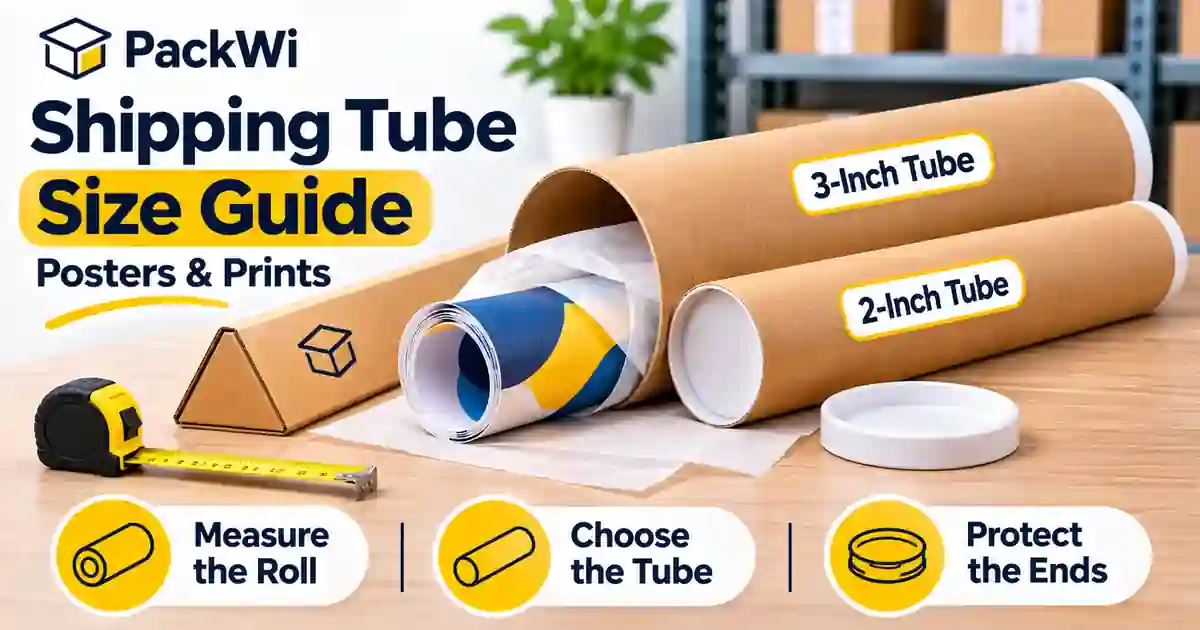

Posters, maps, illustrations, and large printed documents can be difficult to ship safely. A flat envelope may bend, while an oversized box can leave too much room for the contents to move.
A rigid shipping tube offers another option, allowing suitable prints to travel in a rolled position.
But choosing the right tube involves more than matching its length to the poster. The diameter, usable inside space, end caps, paper thickness, and shipping carrier’s rules all matter.
This shipping tube size guide explains how to measure rolled prints, compare common tube dimensions, choose suitable packaging, and avoid damage during transportation.
You’ll also find a practical size chart, three packing examples, and a checklist for preparing your next shipment.
What Is a Shipping Tube?
A shipping tube is a long, rigid container designed to hold rolled documents, posters, drawings, and other suitable products.
Many mailing tubes are made from spiral-wound paperboard. Others use triangular or rectangular corrugated cardboard designs.
Round tubes typically have removable or fitted end caps, while triangular mailers often close with folded cardboard ends.
Common uses include:
- Posters and art prints
- Large drawings and architectural plans
- Maps and charts
- Suitable rolled photographs
- Educational displays
- Certain promotional banners
- Other flexible printed materials
Not every printed item should be rolled.
Thick cardstock, brittle paper, delicate coatings, mounted artwork, and certain valuable prints may crack, crease, or become distorted when curved.
When rolling may damage the item, a properly supported flat package is generally a better option.
Shipping Tube Size Chart: Common Dimensions
Shipping tubes are usually described using two measurements:
Inside diameter × usable length
For example, a tube labeled 3 × 24 inches may have an internal diameter of 3 inches and a usable length of 24 inches.
The following chart shows tube dimensions commonly offered by packaging suppliers.
| Inside diameter | Usable length | Products worth evaluating |
|---|---|---|
| 1.5 in | 12 in | Small flexible prints or rolled documents |
| 2 in | 18 in | Compact posters and suitable short-width prints |
| 2 in | 24 in | Medium posters and rolled papers |
| 2.5 in | 30 in | Larger prints needing additional roll space |
| 3 in | 24 in | Medium artwork with a more generous roll diameter |
| 3 in | 30 in | Larger posters and drawings |
| 3 in | 36 in | Long rolled prints and suitable plans |
| 3 in | 48 in | Oversized drawings and banners |
These are examples of commercially available dimensions, not universal standard sizes or guaranteed fit recommendations. Availability and specifications differ by supplier. See JPack’s mailing tube specifications.
The correct tube depends on the measured rolled package, not simply the original poster dimensions.
Inside Diameter vs. Outside Diameter
One of the biggest sources of confusion is the difference between a tube’s internal and external measurements.
Inside Diameter
The inside diameter describes the usable width across the tube’s opening.
This determines whether the protected rolled item will fit inside without being squeezed.
For example, a rolled poster measuring 2.4 inches across will not fit comfortably into a tube with a 2-inch internal diameter.
A larger diameter is needed.
Outside Diameter
The outside diameter includes the thickness of the tube’s cardboard wall.
This matters when measuring the completed package for a shipping label.
For example, Uline lists a kraft mailing tube with:
- Inside diameter: 2 inches
- Usable length: 18 inches
- Outside diameter: approximately 2.14 inches
- Overall outside length: 19 inches
These measurements illustrate why the supplier’s usable dimensions may differ from the measurements used for shipping charges.
The values apply to that particular tube product, not every tube with the same nominal size.
How to Measure a Rolled Poster
To choose the correct shipping tube, you need two measurements:
- The length of the roll, measured from one paper edge to the other along the tube’s axis.
- The outside diameter of the protected roll, measured across its widest point.
Step 1: Check Whether the Print Can Be Rolled
Before rolling the poster, consider the paper type.
Flexible ordinary poster paper is usually easier to roll than thick, rigid, or heavily coated material.
If the print resists rolling or begins to crease, stop rather than forcing it into a narrow tube.
For delicate or valuable paper artifacts, specialist preservation guidance may recommend flat shipping or rolling around a wide supporting core.
Step 2: Choose the Roll Direction
A rectangular poster can be rolled in different directions.
For example, an 18 × 24-inch poster could be rolled so that the finished roll is approximately 18 inches long or approximately 24 inches long.
The choice affects the tube length and the amount of paper wrapped around the roll.
Choose a direction that is appropriate for the paper and avoids excessive bending.
Step 3: Add Suitable Protective Paper
Use a clean protective sheet when appropriate.
For valuable or sensitive artwork, conservation-appropriate materials may be needed to avoid rubbing, transferring substances, or damaging the printed surface.
Step 4: Roll Gently
Roll the print without making tight creases.
Avoid trying to reduce the roll diameter by forcing the paper into an excessively tight spiral.
Step 5: Measure the Protected Roll
Once the item is safely rolled and protected, measure its actual:
- Axial length
- Outer diameter
These are the measurements to compare with the tube’s usable interior.
How Much Extra Length Should a Shipping Tube Have?
A shipping tube should be long enough for the rolled item and any required end protection.
A simple planning formula is:
Minimum usable tube length = Roll length + End protection allowance
For instance, suppose your protected poster roll measures 18 inches long.
If your packing method requires 0.5 inch of protective clearance at each end:
18 + 0.5 + 0.5 = 19 inches
You would need a tube with at least 19 inches of usable length.
A commercially available 24-inch tube could be considered, but the additional empty length would need appropriate stabilization so the print doesn’t slide.
This example is an estimate, not a universal packaging rule.
Different end caps, cushioning materials, and artwork conditions require different amounts of space.
Important: Measure the usable length with the caps fitted. Some end caps extend into the tube and reduce the available space.
Example 1: Shipping an 11 × 17-Inch Poster
Imagine shipping a lightweight poster measuring:
11 × 17 inches
Suppose the poster can be safely rolled with the 11-inch side forming the length of the roll.
After adding protective wrapping, the finished roll measures:
- Length: 11.5 inches
- Outside diameter: 1.6 inches
These are hypothetical measurements for illustration.
A tube with an inside diameter of 2 inches and a usable length of 18 inches could accommodate the stated measurements.
However, the unused length would need suitable end stabilization.
A shorter, properly fitting tube might be more efficient if available.
What Should You Check?
- Does the protected roll fit without pressure?
- Can the caps close without touching or crushing the paper ends?
- Will the roll remain stable during transportation?
- Is the tube strong enough for the shipment?
A tube that is longer than necessary is not automatically safer.
Example 2: Shipping an 18 × 24-Inch Poster
Now imagine shipping a flexible poster measuring:
18 × 24 inches
You decide to roll it with the 18-inch side forming the roll’s axial length.
After adding appropriate protective material, suppose the roll measures:
- Length: 18.5 inches
- Diameter: 2.3 inches
A 3 × 24-inch tube is a possible candidate.
Its internal diameter would provide room for the 2.3-inch roll, and its usable length would exceed the 18.5-inch bundle.
However, you would need to stabilize the roll so it doesn’t slide from end to end.
What If the Roll Is Too Tight?
A larger-diameter tube may be a better solution.
Don’t compress or bend the poster simply to make it fit a smaller tube.
For certain print materials, a more gradual curve helps reduce the risk of creasing or damage.
Example 3: Shipping a 24 × 36-Inch Art Print
A 24 × 36-inch print creates a larger packaging challenge.
Suppose the print can safely be rolled so the roll is approximately 24 inches long.
The protected roll might require:
- Extra space at both ends
- A wider diameter to avoid excessive bending
- Additional protective material
- A strong outer tube
A 3 × 30-inch tube might be worth investigating if the protected roll’s measured diameter fits.
However, a 3-inch diameter is not automatically safe for every 24 × 36-inch print.
Thicker paper, valuable artwork, and sensitive coatings may need a wider supporting core, a much larger outer tube, or flat shipping.
For especially delicate paper artifacts, the Northeast Document Conservation Center recommends evaluating flat transport where possible and using substantial internal support when rolling is appropriate.
Round Shipping Tubes vs. Triangular Mailing Tubes
Round and triangular mailing tubes can both be useful, but their designs have different advantages.
| Feature | Round tube | Triangular mailer |
|---|---|---|
| Shape | Cylindrical | Triangular prism |
| Common material | Rigid spiral-wound paperboard | Folded corrugated cardboard |
| Storage before use | Usually maintains its shape | Some designs store flat |
| End closure | Often uses fitted caps | Often uses folded cardboard ends |
| Rolling on flat surfaces | Can roll | Generally stays in place |
| Usable interior | Defined by diameter and length | Depends on triangular interior dimensions |
| Suitable products | Rolled posters and other appropriate items | Rolled prints and suitable long products |
DHL notes that triangular tubes can be convenient because they don’t roll on flat surfaces and some versions are supplied flat-packed.
Neither shape automatically guarantees lower shipping costs or better protection.
The right choice depends on the product and carrier requirements.
How to Pack a Poster in a Shipping Tube
Once you’ve selected a suitable tube, prepare the print carefully.
Step 1: Prepare a Clean Surface
Work on a clean, dry table large enough to support the unrolled print.
Remove anything that might scratch or stain the paper.
Step 2: Check the Print’s Condition
Inspect the surface for creases, tears, or damage.
If the print is valuable, consider documenting its condition before packing.
Step 3: Add a Protective Layer
Use an appropriate clean protective sheet around the print.
For sensitive artwork, choose suitable conservation-grade materials rather than ordinary packing paper.
Step 4: Roll Without Excessive Force
Roll the print carefully, following the paper’s natural flexibility.
Do not force a thick or brittle print into a tight roll.
Step 5: Secure the Protective Wrapping
Secure the outer protective wrapping rather than applying tape directly to the print.
Avoid tight elastic bands that could crease or indent the paper.
Step 6: Place the Roll in the Tube
Insert the protected roll carefully.
Avoid scraping exposed print edges against the tube’s opening.
Step 7: Stabilize the Ends
Add suitable end protection if required.
The print should not move freely or strike the caps during handling.
At the same time, avoid packing so tightly that the ends become compressed.
Step 8: Close and Secure the Tube
Fit the end caps or fold the tube closures according to the manufacturer’s instructions.
USPS packaging standards specify that friction-fit sliding end caps require reinforced closures, including tape around the seams.
Do not assume a loosely fitted cap will remain in place during transportation.
Step 9: Attach the Shipping Label
Place the shipping label securely on the outside of the finished package.
Make sure the barcode remains readable and that the label is not distorted by the tube’s shape.
Follow the carrier’s specific labeling requirements.
How to Protect the Ends of a Shipping Tube
A rolled poster can suffer edge damage even if the main tube remains intact.
This may happen when the roll slides lengthwise and repeatedly contacts an end cap.
To reduce that risk:
- Allow appropriate clearance at both ends.
- Use suitable protective material to limit movement.
- Avoid direct pressure against the print’s edges.
- Make sure the caps fit securely.
- Check that the package doesn’t rattle or slide excessively.
Be particularly careful with heavy paper or layered rolls, which can exert greater pressure on the tube ends.
A properly secured tube protects both the sides and the ends of the contents.
Can Every Poster Be Shipped Rolled?
No.
Some materials should remain flat.
Items that may require a different approach include:
- Thick cardstock
- Brittle historical paper
- Mounted photographs
- Art with raised or textured surfaces
- Prints with cracking or unstable coatings
- Particularly valuable or delicate artworks
A print that bends easily isn’t necessarily safe to roll tightly.
For high-value or conservation-sensitive materials, specialist advice may be appropriate.
For ordinary flexible posters, rolling may be practical when the tube diameter is sufficiently generous.
How Shipping Tube Dimensions Affect Postage
Shipping tubes are not always priced like ordinary rectangular boxes.
Carrier rules may consider:
- Overall package length
- External diameter or other outside dimensions
- Package weight
- Length plus girth
- Nonstandard package shape
- Dimensional-weight rules
- Additional handling or processing charges
What Is Girth?
Girth is the distance around the thickest part of a package, excluding its length.
For a cylindrical tube, it corresponds to the circumference.
The general formula is:
Girth = π × Outside diameter
For example, if the tube has an outside diameter of 3.2 inches:
3.1416 × 3.2 ≈ 10.1 inches
If the completed tube is 26 inches long:
Length + girth ≈ 36.1 inches
This measurement may be relevant when checking carrier package-size limits.
Does USPS Charge Extra for Shipping Tubes?
Certain USPS services impose nonstandard or processing-related fees on cylindrical parcels, and length-related charges may also apply.
The current amount depends on the service and applicable rules.
USPS also has specific standards for fiberboard tubes and the way their end closures must be secured.
Before buying postage, check the current USPS package size and fee information.
Don’t assume that a lightweight poster tube will automatically qualify for the same postage as a flat envelope.
Shipping Tube vs. Flat Packaging: Which Is Better?
| Situation | Packaging worth considering |
|---|---|
| Ordinary flexible poster | Properly sized rigid tube |
| Large architectural drawing | Tube if the material can safely be rolled |
| Thin, sensitive art print | Evaluate rolling suitability carefully |
| Thick rigid printed card | Flat rigid mailer or box |
| Mounted photographic print | Suitable flat protective packaging |
| Rare or brittle document | Specialist conservation packaging |
The best packaging method is the one that protects the actual item, not necessarily the one using the least space.
Five Common Shipping Tube Mistakes
1. Choosing the Tube Based Only on Poster Length
A poster may fit lengthwise but become damaged by an excessively tight roll.
Better approach: Measure both the protected roll’s length and diameter.
2. Ignoring the Space Taken by End Caps
Some tube closures reduce the usable interior.
Better approach: Check the manufacturer’s usable length specifications.
3. Leaving the Roll Loose
An unsecured roll can move and damage its edges.
Better approach: Stabilize the contents with appropriate protective materials.
4. Using a Tube for Paper That Should Remain Flat
Thick or brittle prints may crease when rolled.
Better approach: Evaluate the material before choosing cylindrical packaging.
5. Forgetting Nonstandard Shipping Charges
Round tubes may be subject to different pricing rules from rectangular parcels.
Better approach: Obtain a quote using the finished package’s actual dimensions, weight, and shape.
Shipping Tube Packing Checklist
Before shipping, verify the following:
- The poster or print can be safely rolled.
- Its surface is protected by suitable materials.
- The roll was formed without excessive pressure.
- The protected roll’s length has been measured.
- The protected roll’s diameter has been measured.
- The tube has sufficient usable internal dimensions.
- Both ends of the roll have appropriate protection.
- The contents cannot slide freely.
- The end caps or closures are secured.
- The shipping label is readable.
- The completed tube has been measured and weighed.
- The carrier’s shape and size rules have been checked.
Frequently Asked Questions
What size shipping tube do I need for an 18 × 24-inch poster?
It depends on which direction the poster is rolled and the final diameter of the protected roll. A 3 × 24-inch tube might be suitable for some safely rolled posters, but you should measure the actual roll before selecting a tube.
Is a 2-inch tube large enough for posters?
Sometimes. A 2-inch internal diameter can accommodate certain small, flexible rolled prints. Thicker or more delicate materials may need a larger diameter.
Are mailing tube sizes measured inside or outside?
Many suppliers describe cylindrical mailing tubes using their internal diameter and usable length. Shipping carriers typically require measurements of the finished package’s outside dimensions.
Can I ship a poster without a tube?
Yes. If the poster should remain flat, use appropriate rigid cardboard protection and a suitable shipping container.
Are triangular mailing tubes better than round tubes?
Not universally. Triangular tubes generally don’t roll on flat surfaces, while round tubes can be convenient for cylindrical rolls. Protection and shipping costs depend on the exact packaging and carrier.
Should I tape the end caps of a mailing tube?
Use the manufacturer’s instructions and carrier requirements. USPS specifies reinforced closures for certain friction-fit tube caps.
Can I ship several posters in the same tube?
Possibly, if the combined roll fits without excessive pressure and the individual prints are adequately protected. Valuable or delicate prints may need separate protection.
Do shipping tubes cost more to mail?
They can, depending on the carrier and service. Shape-related fees, overall length, weight, and other measurements can affect the final postage.
Final Thoughts
The most reliable way to choose a mailing tube is to measure the protected rolled item first.
Compare its length and outside diameter with the tube’s usable internal dimensions, allow suitable end protection, and secure the closures carefully.
For flexible posters, a rigid tube can be a practical shipping solution. For delicate, brittle, or rigid artwork, flat packaging may be more appropriate.
Before sending the package, measure its exterior dimensions and confirm the relevant carrier rules.
Choosing a tube that fits properly can help protect print edges, limit unwanted movement, and reduce avoidable packing mistakes.
Additional Technical References
PackWi provides general packaging information. Examples are illustrative and do not represent laboratory testing. Tube specifications and carrier requirements vary by manufacturer, service, and destination.