
A package can be lightweight and still exceed a shipping carrier’s size limits. This often happens with long boxes, bulky cartons, and mailing tubes.
One measurement that helps determine package size is girth.
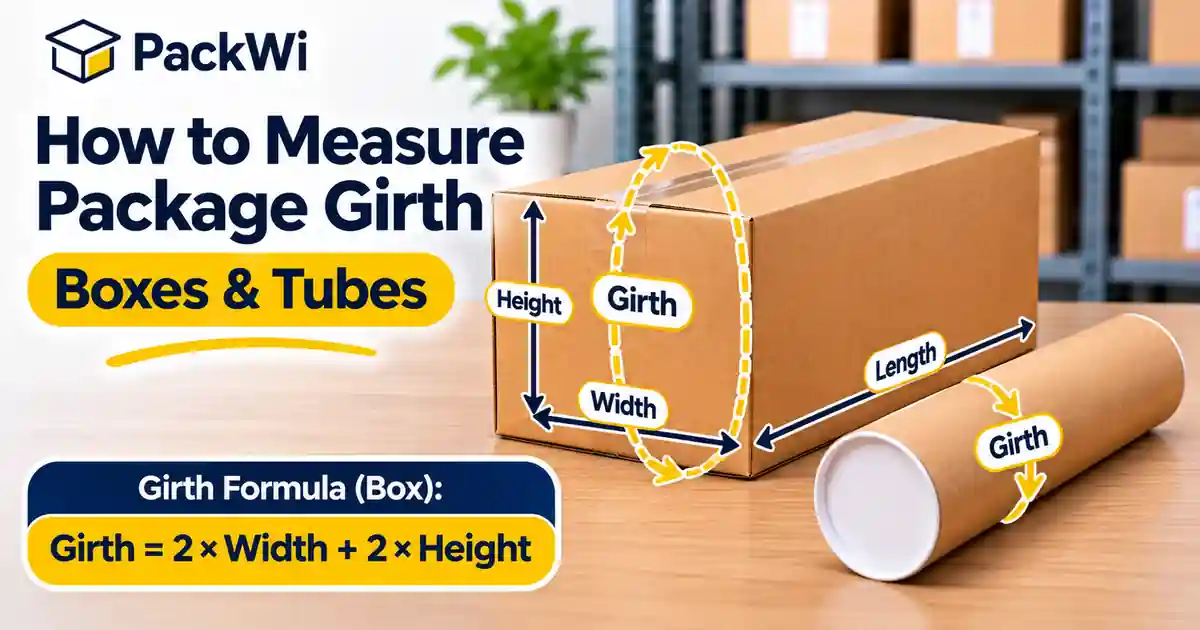
Girth describes the distance around a parcel, measured perpendicular to its length. When combined with the package’s longest dimension, it creates a measurement called length plus girth.
Learning how to measure package girth helps you prepare accurate shipping dimensions, compare packaging options, and check whether a parcel meets a carrier’s size requirements.
This guide explains the formulas for rectangular boxes and cylindrical tubes, provides step-by-step examples, and shows why two packages with the same volume can have different length-plus-girth measurements.
What Is Package Girth?
Package girth is the distance around the thickest part of a shipment, excluding its length.
Imagine placing a flexible measuring tape around the shorter sides of a cardboard box. The distance around that cross-section is its girth.
For a rectangular shipping box, girth depends on two measurements:
- Width
- Height
The package’s length is measured separately.
Carriers often combine length and girth when assessing whether a parcel meets size restrictions or qualifies for certain services.
Girth vs. Length Plus Girth
These measurements are related but not identical.
Girth: The distance around the package, perpendicular to its longest side.
Length plus girth: The package’s longest dimension added to its girth.
For example, a box might have a girth of 40 inches and a length of 30 inches.
Its combined length and girth would be:
30 + 40 = 70 inches
Knowing the difference helps avoid entering incorrect measurements when calculating shipping costs.
How to Measure Girth on a Rectangular Box
For a regular rectangular package, the formula is:
Girth = (2 × Width) + (2 × Height)
Or, more simply:
Girth = 2 × (Width + Height)
To calculate the combined measurement:
Length plus girth = Length + (2 × Width) + (2 × Height)
These formulas are used in the shipping guidance published by UPS and FedEx.
Step-by-Step Measurement
Step 1: Finish packing the box.
Add all contents and protective materials, close the flaps, and seal the box.
Step 2: Find the longest side.
The longest external dimension is normally recorded as the package length.
Step 3: Measure the width and height.
Use the other two external dimensions.
Measure across any bulging areas rather than assuming the box remains perfectly rectangular.
Step 4: Follow the carrier’s rounding rules.
Some services require package dimensions to be rounded upward before calculating girth.
Step 5: Calculate the girth.
Double the width, double the height, and add those results.
Step 6: Add the length.
The result is the package’s combined length and girth.
Example 1: Calculating Girth for a Standard Shipping Box
Suppose a sealed box measures:
| Dimension | Measurement |
|---|---|
| Length | 24 inches |
| Width | 14 inches |
| Height | 10 inches |
First, calculate the girth:
Girth = (2 × 14) + (2 × 10)
Girth = 28 + 20 = 48 inches
Then add the length:
Length plus girth = 24 + 48 = 72 inches
The results are:
- Girth: 48 inches
- Length plus girth: 72 inches
These numbers describe the package’s dimensions. They are not a shipping price.
To determine whether the package qualifies for a service, compare the combined measurement with the carrier’s current limits.
Example 2: Measuring a Larger Box
Now consider a larger package measuring:
| Dimension | Measurement |
|---|---|
| Length | 40 inches |
| Width | 20 inches |
| Height | 15 inches |
Calculate girth:
Girth = (2 × 20) + (2 × 15)
Girth = 40 + 30 = 70 inches
Add the length:
Length plus girth = 40 + 70 = 110 inches
The combined measurement is 110 inches.
Depending on the carrier and service, this measurement could affect eligibility or additional charges.
The package’s actual weight, dimensions, shape, and shipping destination may also matter.
Don’t assume that a package is acceptable simply because it is under a carrier’s maximum weight.
Package Girth Quick-Reference Chart
This table shows calculated measurements for several rectangular packages.
| Box dimensions (L × W × H) | Girth | Length + girth |
|---|---|---|
| 12 × 10 × 8 in | 36 in | 48 in |
| 20 × 14 × 10 in | 48 in | 68 in |
| 24 × 14 × 10 in | 48 in | 72 in |
| 30 × 18 × 12 in | 60 in | 90 in |
| 36 × 20 × 15 in | 70 in | 106 in |
| 40 × 20 × 15 in | 70 in | 110 in |
| 48 × 30 × 25 in | 110 in | 158 in |
All examples use the rectangular-box formula and whole-inch dimensions.
The chart is a mathematical reference, not a guarantee that a particular package qualifies for a shipping service.
Carrier limits and pricing requirements vary.
Why Rounding Can Change the Result
A small difference in measurements can affect the number entered into a shipping system.
Suppose a finished package measures:
- Length: 35.2 inches
- Width: 20.1 inches
- Height: 14.3 inches
The unrounded calculation would be:
35.2 + (2 × 20.1) + (2 × 14.3)
= 104 inches
But UPS’s U.S. dimension guidance instructs shippers to round package dimensions up to whole inches.
Following that approach, the measurements become:
- Length: 36 inches
- Width: 21 inches
- Height: 15 inches
The calculation is now:
36 + (2 × 21) + (2 × 15)
= 36 + 42 + 30
= 108 inches
That’s a difference of 4 inches.
What This Example Teaches Us
Measure carefully, but don’t ignore the shipping service’s required rounding method.
Also, avoid deliberately entering smaller numbers to reduce the calculated size.
Inaccurate package measurements can result in corrections, additional charges, or service problems.
How to Measure Girth on a Round Shipping Tube
A cylindrical mailing tube has a different cross-section from a rectangular box.
For a circle, the distance around the outside is called its circumference.
USPS explains that the girth of a cylindrical package is its circumference.
The mathematical formula is:
Circular girth = π × Outside diameter
Where π is approximately 3.1416.
The diameter must be measured across the outside of the completed tube, not its internal opening.
Example 3: Calculating Circular Tube Girth
Imagine a mailing tube with:
- Outside length: 26 inches
- Outside diameter: 3.2 inches
Calculate the circumference:
Girth = 3.1416 × 3.2
Girth ≈ 10.05 inches
Now add the tube length:
26 + 10.05 ≈ 36.05 inches
So the geometric length-plus-circumference measurement is approximately 36.1 inches, shown to one decimal place.
This is an educational calculation before applying any carrier-specific rounding rules.
Important: Not Every Carrier Measures Tubes the Same Way
Do not assume that every carrier uses the mathematical circumference to determine a tube’s shipping dimensions.
UPS and FedEx publish guidance for measuring irregularly shaped parcels using an imaginary rectangular container around their outermost points.
For a tube with an outside diameter of 3.2 inches, a rectangular bounding measurement would use that diameter as both the width and height.
If a particular service requires those dimensions to be rounded upward to whole inches, the entered width and height could become 4 inches each.
That would create a different length-plus-girth result from the circular circumference method.
Always check the carrier’s measurement procedure for the exact type of package you’re shipping.
For USPS, see its Parcel Size, Weight, and Fee Standards.
Rectangular Box vs. Round Tube: Measurement Comparison
| Measurement question | Rectangular box | Round tube |
|---|---|---|
| How is length determined? | Longest outside dimension | Overall outside tube length |
| What cross-section is measured? | Rectangle | Circle or carrier-required bounding shape |
| Geometric girth formula | 2 × Width + 2 × Height | π × Outside diameter |
| Are outside dimensions important? | Yes | Yes |
| Can carrier rules change the entered measurement? | Yes | Yes |
| Does shape affect shipping requirements? | Potentially | Potentially |
The purpose of this table is to distinguish geometric calculations from the measurements required by a shipping provider.
Always use the carrier’s specified method when purchasing postage or creating a shipping label.
Can Two Boxes Have the Same Volume but Different Girth?
Yes. This is an important detail that is easy to overlook.
Consider two hypothetical shipping boxes.
Box A: 60 × 10 × 10 inches
Box B: 30 × 20 × 10 inches
Both have exactly the same volume:
60 × 10 × 10 = 6,000 cubic inches
30 × 20 × 10 = 6,000 cubic inches
But their length-plus-girth measurements differ.
Box A
Girth = 2 × 10 + 2 × 10 = 40 inches
Length plus girth = 60 + 40 = 100 inches
Box B
Girth = 2 × 20 + 2 × 10 = 60 inches
Length plus girth = 30 + 60 = 90 inches
| Measurement | Box A | Box B |
|---|---|---|
| Dimensions | 60 × 10 × 10 in | 30 × 20 × 10 in |
| Volume | 6,000 in³ | 6,000 in³ |
| Girth | 40 in | 60 in |
| Length + girth | 100 in | 90 in |
Both boxes occupy the same cubic volume, but Box A has a combined length and girth that is 10 inches greater.
This demonstrates why package volume and length-plus-girth measurements serve different purposes.
It doesn’t mean either box is automatically cheaper to ship.
Package shape, the shipping service, and other pricing rules still matter.
Girth vs. Dimensional Weight
Girth and dimensional weight are often discussed together, but they are not the same calculation.
Girth
Girth describes the distance around a package’s cross-section.
Carriers may use length plus girth to assess package dimensions and service restrictions.
Dimensional Weight
Dimensional weight is a calculated weight based on a package’s volume.
For rectangular packages, the general formula is:
Dimensional weight = Length × Width × Height ÷ Applicable divisor
The divisor and rounding requirements vary by service.
Why the Difference Matters
A shipping box can have:
- A relatively low actual weight
- A high dimensional weight
- A large length-plus-girth measurement
Each of these characteristics can affect shipping requirements differently.
A package can also have a moderate length-plus-girth measurement while still occupying substantial cubic space.
For an accurate shipping comparison, record both the package dimensions and its actual packed weight.
How Does Girth Affect Shipping Costs?
Length plus girth is relevant because carriers set dimensional restrictions for the parcels they accept.
Certain services may also apply additional handling, oversized-package, or other charges based on package characteristics.
For example, UPS’s U.S. package guidance lists a maximum combined length and girth of 165 inches for its applicable small-package services.
However, individual services, locations, and account arrangements may have additional limits.
USPS uses different maximum dimensions and fees depending on the service and package characteristics.
You should not assume that reaching a service’s maximum is free of additional charges.
Before Comparing Shipping Prices
Record:
- Finished outside length
- Finished outside width
- Finished outside height
- Length plus girth
- Actual packed weight
- Package shape
- Origin and destination
- Shipping service
Then enter the appropriate information into the carrier’s official shipping calculator.
For UPS measurement details, see UPS Shipping Dimensions and Weight.
How to Reduce Unnecessary Package Girth
Reducing package dimensions can be useful, but it should never compromise product protection.
Choose a Box That Fits the Product
An excessively large shipping box may increase both volume and girth.
Measure the item with its required protective materials before choosing the container.
For more guidance, read PackWi’s How to Choose the Right Shipping Box Size.
Avoid Bulging Sides
A box that is overfilled may no longer retain its intended shape.
This can affect its outside dimensions and structural integrity.
Use a box with sufficient internal room instead of forcing the flaps closed.
Consider a Different Packaging Shape
Some suitable products can be packed in more than one orientation.
Depending on the item, an alternative box shape may reduce its combined length and girth.
However, the finished package still needs sufficient cushioning and structural support.
Use Appropriate Packaging for Long Products
Long, narrow products sometimes fit better in a purpose-designed tube or long rectangular mailer.
Before selecting either option, compare the carrier’s shape-related requirements and the protection the item needs.
Five Common Girth Measurement Mistakes
Mistake 1: Using Internal Box Dimensions
Internal dimensions describe usable packing space.
Shipping measurements generally require the completed package’s exterior dimensions.
Better approach: Measure the finished package after sealing it.
Mistake 2: Choosing the Wrong Length
For a rectangular package, length is generally the longest outside dimension.
Better approach: Identify the longest side before calculating girth.
Mistake 3: Forgetting to Double Width and Height
Girth is not simply width plus height.
Better approach: Use 2 × Width + 2 × Height.
Mistake 4: Treating Every Tube Like a Box
Circular and irregular packages can require different measurement methods.
Better approach: Check how the specific carrier handles nonrectangular shipments.
Mistake 5: Ignoring Rounding Rules
Small fractions can affect the dimensions entered into a shipping system.
Better approach: Follow the applicable carrier’s rounding instructions.
Package Girth Measurement Checklist
Before creating a shipping label, confirm the following:
- The package is fully packed and sealed.
- All dimensions are measured on the outside.
- Bulging or projecting areas are included.
- The longest dimension has been identified.
- The correct measurement method is being used for the package shape.
- Carrier-specific rounding rules have been applied.
- Girth has been calculated.
- Length plus girth has been calculated.
- The completed package has been weighed.
- Carrier limits and potential additional fees have been checked.
Frequently Asked Questions
How do you measure package girth?
For a rectangular shipping box, measure its outside width and height. Multiply each by two, then add the results.
What is the formula for length plus girth?
For a rectangular box:
Length + (2 × Width) + (2 × Height)
Length is generally the longest outside dimension.
Is girth the same as circumference?
For a cylindrical package, geometric girth is the circumference around the tube. For rectangular packages, girth is the perimeter around the cross-section.
Carrier-specific measurement rules may differ for irregular shapes.
Does girth include package length?
No. Girth is measured around the package. Length is added separately when calculating length plus girth.
Can girth affect shipping prices?
Yes. Carriers may use combined length and girth to determine size eligibility and whether certain fees apply. The final price depends on the service and other shipment details.
Should I measure a box before or after packing it?
Measure the completed, closed package. The outside dimensions can differ from those listed by the box manufacturer.
Does dimensional weight use the girth formula?
No. Dimensional weight generally uses the package’s volume and an applicable divisor, while girth describes its perimeter.
What if my package is an irregular shape?
Follow the shipping company’s specific measurement instructions. Some carriers use a hypothetical rectangular box around the package’s outermost points.
Final Thoughts
Understanding how to measure package girth helps you prepare more accurate shipments and avoid confusion when comparing carrier size requirements.
For rectangular boxes, use:
Girth = 2 × Width + 2 × Height
Then add the longest dimension to find length plus girth.
For tubes and irregularly shaped packages, check the applicable carrier’s measurement method before entering dimensions.
Finally, remember that girth, volume, dimensional weight, and actual weight describe different characteristics of a shipment.
Accurate measurements, suitable protective packaging, and a reliable carrier quote are the best starting points for making informed shipping decisions.
PackWi provides general educational packaging information. All worked examples are illustrative calculations, not actual carrier quotes or physical packaging tests. Size limits, rounding procedures, and fees can change. Verify the applicable shipping rules before sending a parcel.